In today’s digital world, having a website is just the start. To really succeed online, your site must be visible to search engines. Kajal Kumar Roy says, “On-Page SEO is the secret sauce that can send your website much higher in search engine rankings.”
To boost your website’s visibility, you need a smart on-page SEO plan. By tweaking your site’s structure, content, and meta tags, you can climb the search engine ranks. This will also bring more visitors to your site.
Table of Contents:
Key Takeaways
- Understand the importance of on-page SEO for website visibility.
- Learn effective SEO techniques to improve search engine rankings.
- Discover how to optimize your website’s structure and content.
- Enhance your site’s meta tags for better search engine crawling.
- Drive more traffic to your site with improved visibility.
What is On-Page SEO and Why It Matters
Learning about on-page SEO is vital for better search rankings. On-page SEO, also called ‘on-site SEO,’ is about making webpage content better for search engines.
Definition and Scope of On-Page SEO
On-page SEO uses many techniques to make web pages rank higher. It includes optimizing content, meta tags, titles, and links within the site. It covers both the technical and content sides of a website.
A good on-page SEO plan can make a website more visible. Important parts are:
- Keyword research and use
- Meta tag optimization
- Quality and organized content
- Internal linking
| On-Page SEO Element | Description | Importance Level |
|---|---|---|
| Meta Tags | Give search engines info about the page | High |
| Content Quality | Engaging, informative, and well-structured content | High |
| Internal Linking | Helps search engines understand the site structure | Medium |
The Impact of On-Page SEO on Search Rankings
The role of on-page SEO in search rankings is huge. By improving on-page elements, sites can climb the search engine ranking positions (SERPs). This brings more visitors to the site.
Good on-page SEO means better user experience and more sales. The main benefits are:
- More visibility in search results
- Improved website trustworthiness
- Better user experience
Understanding Search Engine Algorithms in 2023
As we explore the world of search engine optimization, knowing about search engine algorithms in 2023 is key. Search engines, like Google, keep updating their algorithms. They do this to give users the best and most relevant content.
How Google Evaluates On-Page Elements
Google looks at on-page elements like their relevance, quality, and how they feel to users. Important things include keyword usage, content structure, and if they work well on mobile devices. Google says a good page should have a clear layout, short meta tags, and enough content to meet user needs.
Google also cares a lot about user experience. Things like page speed, how well the site works on mobile, and not having too many pop-ups are important. By focusing on these, website owners can make their site more visible and ranked higher.
| On-Page Element | Importance | Best Practice |
|---|---|---|
| Keyword Usage | High | Use keywords naturally in content and meta tags. |
| Content Structure | High | Organize content with headers and subheaders. |
| Mobile-Friendliness | Critical | Ensure responsive design for all devices. |
Recent Algorithm Updates Affecting On-Page SEO
Google’s updates, like the Helpful Content Update and Page Experience Update, have changed on-page SEO a lot. These updates focus on content that is not just relevant but also good for the user.
“The goal of our algorithm updates is to reward high-quality content that satisfies user intent, while reducing the visibility of low-quality or unhelpful content.” – Google
To keep up, website owners should make high-quality, engaging content. They should also make sure their site is easy to use. This way, they can get better rankings and more visitors.
Powerful On-Page SEO Techniques That Drive Results
On-page SEO is key in the changing world of search engines. Learning the right methods can greatly increase your website’s visibility to your audience.

Foundational Techniques Every Website Needs
Every website needs basic on-page SEO to rank well. These include:
- Optimizing title tags and meta descriptions to attract clicks.
- Using header tags (H1, H2, H3, etc.) to organize content.
- Creating quality content that naturally includes target keywords.
- Boosting page speed and mobile responsiveness for better user experience.
These basics can help your website rank higher and attract more visitors.
Advanced Strategies for Competitive Niches
In competitive niches, advanced on-page SEO can give you an edge. Some strategies are:
- Schema markup implementation to give search engines more content context.
- Optimizing for featured snippets by answering common questions directly.
- Targeting long-tail keywords for specific, less competitive searches.
- Using internal linking to help users and search engines navigate your site.
Combining basic and advanced techniques can help your website stand out and beat competitors.
Optimizing Title Tags and Meta Descriptions
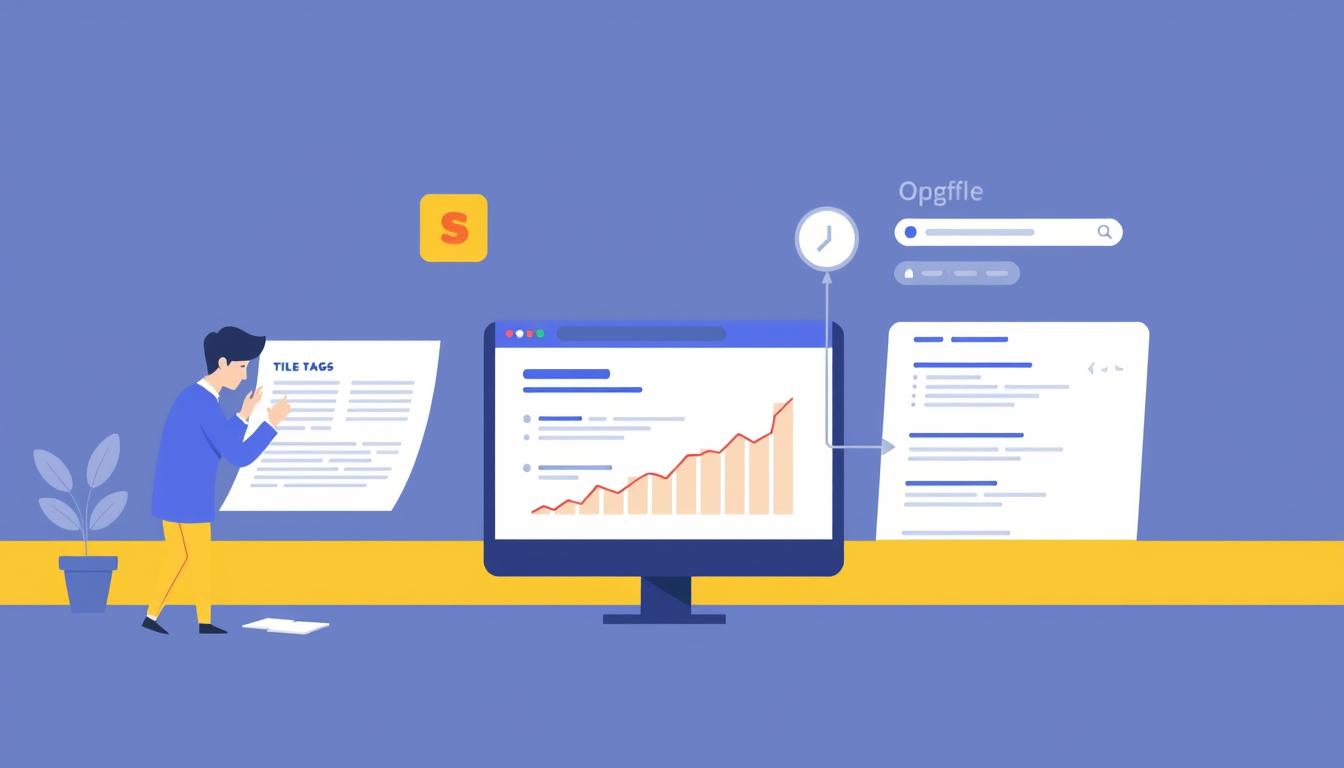
Title tags and meta descriptions are key in on-page SEO. They help your website show up better in search results. Making them good can boost your site’s ranking and get more clicks.
Crafting Click-Worthy Title Tags
Title tags grab attention first in search results. They’re vital for getting people to click on your link. A good title tag should have your target keyword and be catchy.
For example, “Unlock the Secrets of Effective On-Page SEO” is more interesting than a plain title. SEO pros say a great title tag can increase clicks by 20%.
It’s important to balance keyword inclusion with appeal. Your title should be short, clear, and under 60 characters. This prevents it from getting cut off in search results.
Writing Meta Descriptions That Drive Clicks
Meta descriptions give a quick summary of your page’s content. They appear below the title tag in search results. A good meta description should make users want to click on your link.
As Moz advises, aim for a meta description that’s like a mini-ad for your page. Include your target keyword and make it engaging. Aim for 155-160 characters to avoid getting cut off.
“The best meta descriptions are those that are descriptive and persuasive, encouraging users to click through to your website.”
This can greatly improve your site’s click-through rate and SEO performance.
Content Optimization Strategies That Work
To boost on-page SEO, it’s key to use strong content optimization strategies. “Content is your website’s lifeblood, delivering answers to users and context to search engines.” This shows how vital content is in SEO. Good content optimization includes several important strategies that can greatly help your site’s visibility and rankings.
Keyword Research and Implementation
The base of a great content optimization plan is deep keyword research. This means finding the most relevant and popular keywords for your content. Tools like Google Keyword Planner, Ahrefs, and SEMrush can help find the best keywords. After finding your keywords, it’s important to use them naturally in your content, like in the title, headings, and body.
Content Structure and Readability
A well-organized and easy-to-read content is good for both users and search engines. Use clear headings, short paragraphs, and bullet points to make your content better. Readability improves when your content is simple and easy to understand. Also, adding internal and external links can make your content more credible and helpful.
Creating Content That Satisfies User Intent
Understanding and meeting user intent is key for content optimization. Search engines favor content that gives users the most relevant and useful info. To do this, you must know what your audience wants and make your content meet their needs. This means creating content that’s not just informative but also engaging and relevant to what users are searching for.
By using these content optimization strategies, you can greatly improve your website’s visibility, enhance user experience, and attract more visitors to your site.
Header Tags: Organizing Content for Users and Search Engines
Header tags are key to organizing your content. They make it easier for both users and search engines to find what they need. This helps improve your site’s structure and user experience.
By using header tags, you’re helping search engines understand your content better. This can boost your site’s ranking and make it more visible online.
H1-H6 Tag Hierarchy Best Practices
Knowing how to use header tags is important. The H1 tag is for the main title, and H2-H6 tags are for subheadings. Here’s how to do it right:
- Use H1 for the main title
- Use H2 for main subheadings
- Use H3-H6 for further subheadings as needed
Keeping your tags in order helps everyone understand your content. For example, a well-organized article might look like this:
| Header Tag | Usage |
|---|---|
| H1 | Main Title |
| H2 | Main Subheading |
| H3 | Sub-subheading |
Incorporating Keywords in Headers Naturally
Adding the right keywords to your header tags can help your SEO. But, do it naturally and avoid stuffing keywords.
For example, if your main keyword is “on-page SEO,” your H1 could be “Mastering On-Page SEO: Techniques for Better Rankings.” Use different versions of this keyword in your H2 and H3 tags, like “On-Page SEO Strategies” or “Optimizing Content for On-Page SEO.”
“The key to effective header tags is to strike a balance between SEO optimization and readability. Your headers should be descriptive, concise, and engaging.”
Header tags are not just for SEO. They also make your content easier to read and understand. This improves the user experience.

URL Structure and Its Impact on SEO
Optimizing URLs is key to on-page SEO and can greatly affect search rankings. A good URL structure helps search engines understand your site’s content and layout. It also makes your site easier for users to navigate.
Creating SEO-Friendly URLs
To make URLs SEO-friendly, they should be clear, short, and include the right keywords. Avoid using extra characters, numbers, or parameters that can make your URL look spammy or hard to read.
Here are some tips for creating SEO-friendly URLs:
- Use hyphens to separate words
- Include target keywords
- Avoid unnecessary parameters
- Keep the URL short
Managing URL Parameters and Redirects
URL parameters can sometimes lead to duplicate content or confuse search engines. It’s important to know when and how to use them to support SEO.
Redirects are also key in managing URLs, like when you’re changing your site’s structure or updating URLs. Using 301 redirects helps keep link value and ensures a smooth transition for everyone.
| URL Element | Best Practice | Impact on SEO |
|---|---|---|
| URL Structure | Descriptive and concise | Improves crawlability and user experience |
| URL Parameters | Use sparingly and manage effectively | Reduces duplicate content issues |
| Redirects | Use 301 redirects for permanent changes | Preserves link equity and ensures a smooth transition |
Internal Linking: Building a Strong Website Architecture
Internal linking is often overlooked, but it’s very powerful for SEO. A good internal linking strategy makes your site better for users and search engines.
Internal linking helps create a clear site structure. It guides users and search engines through your site. This makes it easier for search engines to find and index your pages.
Strategic Internal Linking Patterns
Creating a smart internal linking plan is key for SEO. It links to content that’s relevant and useful. This makes your site a network of valuable pages for users.
Some good strategies include:
- Linking to cornerstone content from relevant pages
- Creating hub pages that link to related cluster content
- Using internal linking to guide users through a sales funnel or conversion process
Anchor Text Optimization for Internal Links
Anchor text optimization is vital for internal linking. The anchor text should give context to both users and search engines.
Here are some tips for anchor text optimization:
- Use descriptive and concise anchor text
- Avoid generic anchor text like “click here”
- Vary anchor text for links pointing to the same page
By focusing on strategic internal linking patterns and anchor text optimization, you can improve your site’s architecture. This will make your site better for users and boost your search engine rankings.
Image Optimization for Search Visibility
Image optimization is a simple yet effective way to boost your website’s SEO. It improves page speed, user experience, and search engine rankings.
One key aspect is image compression. It reduces file size, leading to faster page loads and better user experience.
Image Compression and Format Selection
There are many ways to compress images. Choosing the right format is also important. JPEG is best for photos, while PNG is better for graphics and icons.
| Image Format | Best Use | Compression Level |
|---|---|---|
| JPEG | Photographs | High |
| PNG | Graphics and Icons | Lossless |
| WebP | Web Images | High |
Alt Text and File Name Optimization
Optimizing alt text and file names is key for image SEO. Alt text describes the image, and file names help search engines understand it.
Use descriptive, keyword-rich alt text. Use hyphens in file names. For example, “image-optimization-techniques.jpg” is better than “IMG123.jpg”.
“The alt attribute provides a text description of the image, which is essential for accessibility and SEO.”
Using Images to Enhance User Experience
Images can make your site more engaging. They break up text, illustrate complex ideas, and make your design look good.
Use high-quality images that match your content. Make sure they are optimized for search engines.

By optimizing your images, you can boost your website’s search visibility. This improves user experience and drives more traffic to your site.
User Experience Factors That Influence On-Page SEO
User experience and on-page SEO work together to boost search rankings. Search engines now value websites that offer a smooth and engaging experience. This section looks at key user experience factors that affect on-page SEO, like page speed, bounce rate, dwell time, and core web vitals.
Page Speed Optimization Techniques
Page speed is how fast your website loads. It’s a big factor in search rankings. To speed up your site, you can compress images, use browser caching, and minify CSS and JavaScript. These steps can make your site load faster, making users happier and improving your rankings.
Some effective page speed optimization techniques include:
- Compressing images to reduce file size without compromising quality.
- Leveraging browser caching to store frequently-used resources locally.
- Minifying CSS and JavaScript files to reduce the amount of code that needs to be loaded.
Reducing Bounce Rate and Increasing Dwell Time
Bounce rate and dwell time show how engaged users are. A high bounce rate hurts your SEO, while a longer dwell time means your content is valuable. To lower bounce rates and increase dwell time, create engaging content that meets user needs. Make sure your site is easy to use and has clear navigation.
Strategies to improve these metrics include:
- Creating engaging, high-quality content that resonates with your audience.
- Improving website usability through clear navigation and responsive design.
- Optimizing content to satisfy user intent and provide value.
Core Web Vitals Optimization
Core Web Vitals are important for a good user experience, according to Google. They include Largest Contentful Paint (LCP), First Input Delay (FID), and Cumulative Layout Shift (CLS). Improving these vitals is key to better user experience and SEO. Focus on LCP, FID, and CLS to make your site perform better and offer a better user experience.
| Core Web Vital | Description | Optimization Technique |
|---|---|---|
| Largest Contentful Paint (LCP) | Measures loading performance. | Optimize images, use lazy loading. |
| First Input Delay (FID) | Measures interactivity. | Minimize JavaScript execution time. |
| Cumulative Layout Shift (CLS) | Measures visual stability. | Use explicit dimensions for media elements. |
By focusing on these user experience factors, you can greatly improve your website’s SEO. It’s important to keep monitoring and improving these areas to stay ahead in search rankings.
Mobile Optimization in the Mobile-First Era
In today’s world, over 51.2% of online traffic comes from mobile devices. Having a mobile-optimized website is key. It shows your site works well on mobiles, which search engines value a lot.
Mobile optimization is now a must for any website wanting to rank high. Most people use their phones to go online. A site not made for mobiles will likely have high bounce rates and a bad user experience.
Responsive Design Elements That Impact SEO
A responsive design is the base of mobile optimization. It makes sure your site works on all devices and sizes. Important parts of responsive design are flexible grids, images, and media queries.
When you make your site responsive, think about page speed too. Mobile users want fast sites. Make images smaller and use browser caching to speed up your mobile site.
Mobile-Specific On-Page SEO Techniques
There are special mobile-specific on-page SEO techniques to help your site show up more in mobile searches. These include making your site work for voice search, having easy-to-use navigation, and making sure content fits on small screens.
Also, mobile-first indexing is important. This means search engines look at your mobile site first for indexing and ranking. Make sure your mobile site has the same quality content as your desktop site to keep your rankings up.
By focusing on mobile optimization, responsive design, and mobile-specific SEO, you can make your website better in the mobile-first era. This improves user experience and helps your site rank higher in search engines.
Technical On-Page SEO Factors
Technical SEO is key to a good SEO plan. It helps search engines see and list your site better. By tweaking technical SEO, you can make your site more visible and rank higher.
Schema Markup Implementation
Schema markup adds extra details to your search results. It makes your content stand out. Google says it helps your site show up better in search results.
To add schema markup, pick the right types for your content. Then, add the code to your HTML. Use Google’s Rich Results Test to check if it’s done right.
Canonical Tags and Duplicate Content
Canonical tags tell search engines which page to choose when there are similar ones. This avoids penalties for duplicate content.
To use canonical tags, find and mark duplicate pages. Add a rel="canonical" tag to point to the main page.
XML Sitemaps and Robots.txt
XML sitemaps and robots.txt files help search engines get your site’s layout. An XML sitemap lists your URLs for easy crawling.
A robots.txt file tells search engines how to crawl your site. Use Disallow to block certain pages and Allow to let others through.
Optimizing these technical SEO elements boosts your site’s visibility and ranking. As Google says, knowing how search engines work is the secret to SEO success.
Conclusion: Implementing a Holistic On-Page SEO Strategy
On-page SEO is a continuous effort that needs constant improvement. As search engine algorithms change, a complete SEO plan is key for lasting success.
By using the methods talked about in this article, like optimizing title tags and meta descriptions, you can make your site more visible. This will help bring more visitors to your website.
A good on-page SEO plan is more than just technical tweaks. It also means understanding what users want and how they behave. This way, you can build a strong SEO strategy that brings long-term benefits.
Working on on-page SEO is an ongoing task. Keep up with the newest SEO practices and updates. This will help your website stay ahead in the fast-changing world of search.