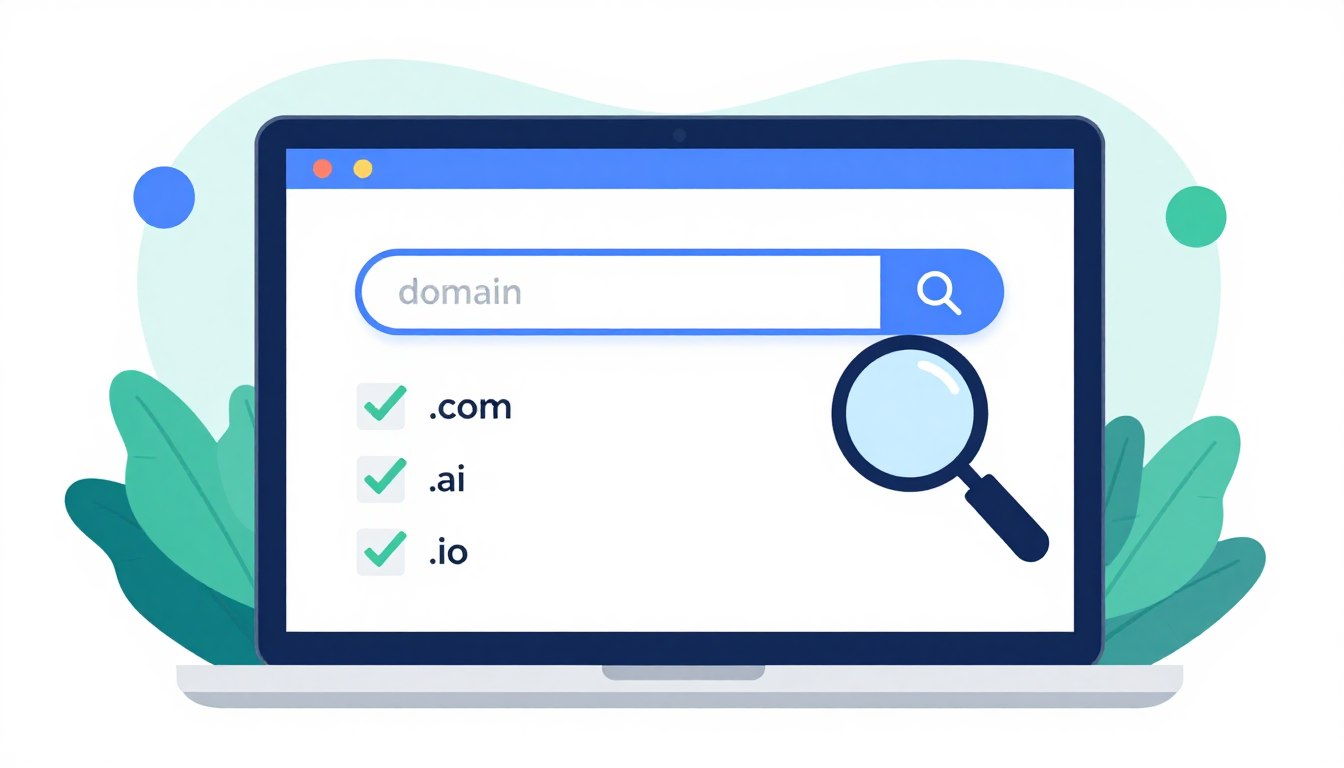
Your domain name is not just a web address. It is your digital identity, your first impression, and a critical foundation for online success in 2026.
With over 350 million registered domains worldwide and thousands added daily, choosing the right domain name has never been more challenging. A poor choice can cost you traffic, credibility, and revenue.
The domain landscape has evolved dramatically. New TLD extensions like .ai are surging in popularity. AI-powered naming tools now generate brand-ready suggestions in seconds. Search engines and AI agents increasingly prioritize memorable, trustworthy domains.
Whether you are launching a startup, rebranding an established business, or creating your first blog, this comprehensive guide delivers actionable domain name tips 2026 that work.
You will discover proven strategies for choosing memorable names, comparing registrars, avoiding costly mistakes, and leveraging AI tools. Plus, get access to our complete 50-point domain checklist to ensure you make the perfect choice.
Ready to secure your ideal domain? Let’s dive into the strategies that will set your website apart in 2026 and beyond.
Table of Contents:
The Domain Name Landscape in 2026
The domain industry has reached unprecedented scale and sophistication in 2026. Understanding current trends helps you make smarter choices for your business or project.
Global domain registrations now exceed 350 million active domains. This massive growth reflects the digital transformation accelerating across all industries and regions.
New generic top-level domains (gTLDs) have exploded to 37.8 million registrations. Extensions like .shop, .tech, .store, and .online offer fresh alternatives to traditional .com domains.
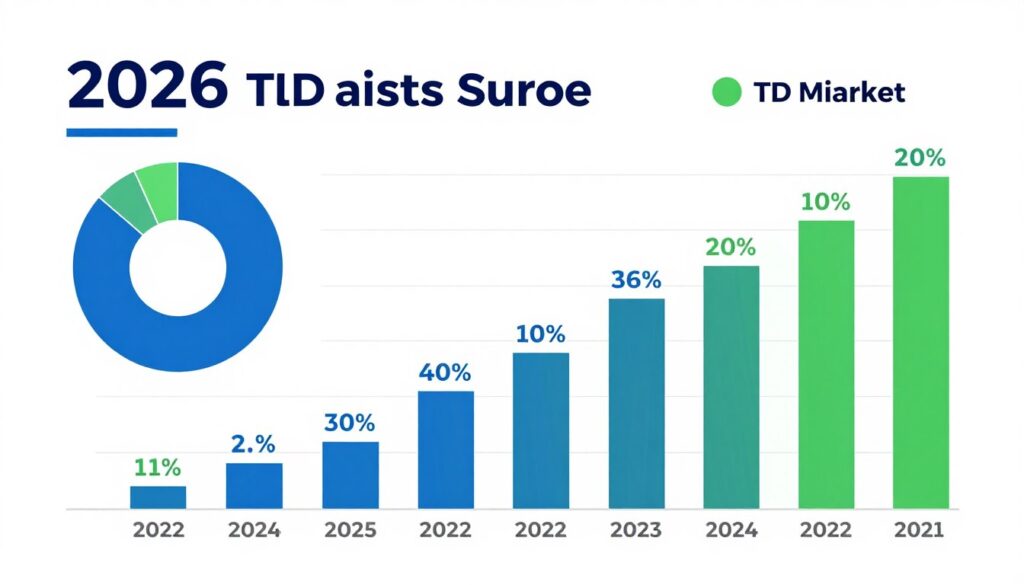
The .ai domain extension has become the fastest-growing TLD in history. Driven by artificial intelligence boom, .ai registrations increased 340% year-over-year. Tech startups and AI-focused companies rush to secure .ai domains for brand positioning.
AI-assisted domain naming tools now power 42% of all domain searches. These intelligent platforms analyze branding trends, check availability across multiple extensions, and generate creative alternatives instantly.
Voice search and AI agents significantly impact domain strategy today. Simple, pronounceable domain names rank higher in voice search results. AI-powered assistants like ChatGPT and Google Bard prioritize domains with clear, trustworthy naming patterns.
Country-code TLDs (ccTLDs) continue strong performance for local businesses. Extensions like .uk, .de, .ca, and .au boost local SEO and build regional trust.
Premium domain prices reached record highs in 2026. Single-word .com domains now average $150,000 to $2 million at auction. Short, memorable domain names remain the most valuable digital real estate.
Security features like DNSSEC and automatic HTTPS are now standard expectations. Domain buyers in 2026 demand built-in security, privacy protection, and SSL certificates as baseline requirements.
Start Your Domain Search with Confidence
Arahoster combines advanced AI domain suggestions with instant availability checking across 500+ extensions. Find your perfect domain name in minutes, backed by 24/7 expert support.
1. Keep It Short, Simple & Memorable
The most successful domain names share one critical characteristic: they are easy to remember. In 2026, attention spans are shorter than ever. Your domain must stick in people’s minds after hearing it just once.
The 15-Character Rule
Aim for domain names under 15 characters. Research shows that shorter domains have 38% higher direct traffic and 27% better brand recall rates.
Analysis of Fortune 500 companies reveals that average successful domain length is just 6.5 characters. Short domains are easier to type, harder to misspell, and more memorable across all marketing channels.
Consider these examples of highly effective short domains: Zoom.com (4 chars), Uber.com (4 chars), Stripe.com (6 chars), and Figma.com (5 chars). Each brand leverages brevity for maximum impact.
The Radio Test
Apply the radio test to every domain candidate. Imagine announcing your domain name on a radio advertisement or podcast. Could listeners spell it correctly after hearing it once?
Domains that fail the radio test include those with unusual spellings, silent letters, or multiple interpretations. For example, “PhotoSynthesisStudios.com” fails because it is too long and complex.
Strong radio test performers use simple, phonetic spelling. “Snap.com” passes perfectly. “Lyft.com” works despite non-standard spelling because pronunciation is obvious.
Pronunciation Clarity
Choose domain names that anyone can pronounce correctly on first attempt. Ambiguous pronunciations create confusion and hurt word-of-mouth marketing.
Avoid domains with multiple pronunciation possibilities. “ReadIt.com” could be “Red-it” or “Reed-it.” This ambiguity weakens brand recognition and verbal sharing.
Test your domain name with friends, family, or colleagues unfamiliar with your project. If multiple people mispronounce it, reconsider your choice.
Spelling Simplicity
Use standard dictionary words or simple invented terms. Complex spellings lead to typos, lost traffic, and frustrated customers searching for your site.
Common spelling mistakes to avoid include replacing letters with numbers (“4” for “for”), using unusual letter combinations, or creating ambiguous vowel sounds.
If you must use a creative spelling, ensure it is intuitive. “Flickr.com” works because the missing “e” is obvious in context. “Flckr.com” would be too obscure.
Avoid Double Letters When Possible
Domain names with double letters often get misspelled. “TreeHouseBusiness.com” risks users typing “TreHouseBusiness.com” or “TreeHouseBusines.com.”
If double letters are unavoidable (like in “Coffee” or “Bee”), consider registering common misspelling variants to capture lost traffic.
Memorability Testing
Conduct simple memorability tests before finalizing your domain choice. Tell someone your domain name once, then ask them to recall it 10 minutes later.
Track success rates across multiple test subjects. If fewer than 80% can recall your domain correctly, consider alternatives.
Memorable domains often use alliteration (PayPal, Coca-Cola), rhyming (YouTube), or vivid imagery (Amazon, Apple).
Single-Word Domains
Single-word domain names deliver maximum memorability and brand power. Unfortunately, most single-word .com domains were registered years ago.
Consider alternative extensions like .ai, .io, or .co for single-word domains. “Genius.ai” or “Market.io” can be just as powerful as their .com equivalents.
You can also explore emerging gTLDs like .tech, .store, or .online for available single-word options at reasonable prices.
Do This
- Keep total length under 15 characters
- Use simple, phonetic spelling
- Choose easily pronounceable words
- Test memorability with real people
- Aim for single words when possible
Avoid That
- Complex multi-word combinations
- Creative spellings that confuse users
- Words with ambiguous pronunciation
- Double letters that invite typos
- Abbreviations only you understand
2. Make It Brandable & Unique
Generic keyword-stuffed domain names rarely build lasting brands in 2026. Today’s successful businesses choose distinctive, brandable domain names that stand apart from competitors.
What Makes a Domain Brandable?
Brandable domain names create strong mental associations and emotional connections. They sound professional, feel modern, and suggest quality without being overly descriptive.
The best brandable domains are invented words, creative combinations, or unexpected term pairings. Think Spotify, Shopify, Netflix, or Venmo.
These names did not exist before their companies created them. Yet each became globally recognized because they are distinctive, memorable, and own-able.
Invented Words vs Keyword Domains
Invented words offer unlimited creative potential. You can trademark them, rank for brand searches, and build unique identity without competition.
Keyword domains like “BestChicagoPizza.com” or “CheapCarInsurance.com” face severe limitations. They blend into crowded markets, appear spammy, and lack differentiation.
While keyword domains may offer minor SEO advantages for specific searches, brandable domains win for long-term growth, customer loyalty, and market positioning.
Creating Invented Brand Names
Combine word fragments to create new terms. “Instagram” merges “instant” and “telegram.” “Pinterest” blends “pin” and “interest.”
Alter spelling of existing words slightly. “Flickr” removes a vowel from “Flicker.” “Tumblr” drops the “e” from “Tumbler.”
Use Latin, Greek, or other language roots. “Adobe” derives from creek name. “Audi” comes from Latin founder name.
Apply word generators and AI tools to spark creative combinations. Tools like Namelix, Squadhelp, and BrandBucket suggest thousands of available invented names.
Uniqueness Verification
Before committing to a brandable name, verify its uniqueness across digital spaces. Search thoroughly to avoid conflicts with existing brands, products, or trademarks.
Check domain availability across all major extensions (.com, .net, .io, .ai). Secure multiple variants to protect your brand.
Search social media platforms to ensure username availability. Consistent naming across domain, Instagram, Twitter, Facebook, and LinkedIn strengthens brand recognition.
Emotional Connection
Effective brandable domains evoke positive emotions or interesting associations. “Asana” suggests serenity and balance. “Canva” implies artistic canvas.
Consider what feelings you want to inspire in customers. Trust? Innovation? Friendliness? Choose sounds and word combinations that align with your desired brand personality.
Avoid negative connotations or unintended meanings in other languages. Research your domain name globally to prevent embarrassing misunderstandings.
Industry Differentiation
Study competitor domain names in your industry. Identify naming patterns, then deliberately choose something different.
If all competitors use descriptive keyword domains, choose an abstract brandable name. If everyone picks invented words, perhaps a simple clear dictionary word stands out.
Differentiation helps you avoid getting lost in the crowd. Unique domains improve brand recall and reduce customer confusion between similar businesses.
Scalability Considerations
Choose brandable domain names that allow business evolution. Avoid overly specific names that limit future expansion.
Amazon.com started selling books but chose a name allowing unlimited category expansion. “AmazingBooks.com” would have constrained growth.
Your brandable domain should work if you expand products, services, or target markets over time. Build flexibility into your naming strategy.
Brandable Domain Advantages
- Unique identity that stands out from competitors
- Trademark protection opportunities
- Greater flexibility for business evolution
- Higher perceived professionalism and value
- Better long-term brand equity building
- Easier to rank for branded search terms
Keyword Domain Limitations
- Generic appearance reduces differentiation
- Limited trademark protection options
- Restricts business scope and expansion
- Often perceived as lower quality or spammy
- Difficult to build emotional brand connection
- Intense competition for keyword rankings
3. Use Keywords Strategically
Keywords in domain names can provide SEO benefits, but they must be balanced with branding considerations in 2026. Smart keyword usage helps search visibility without sacrificing brand identity.
The SEO Reality of Keywords in Domains
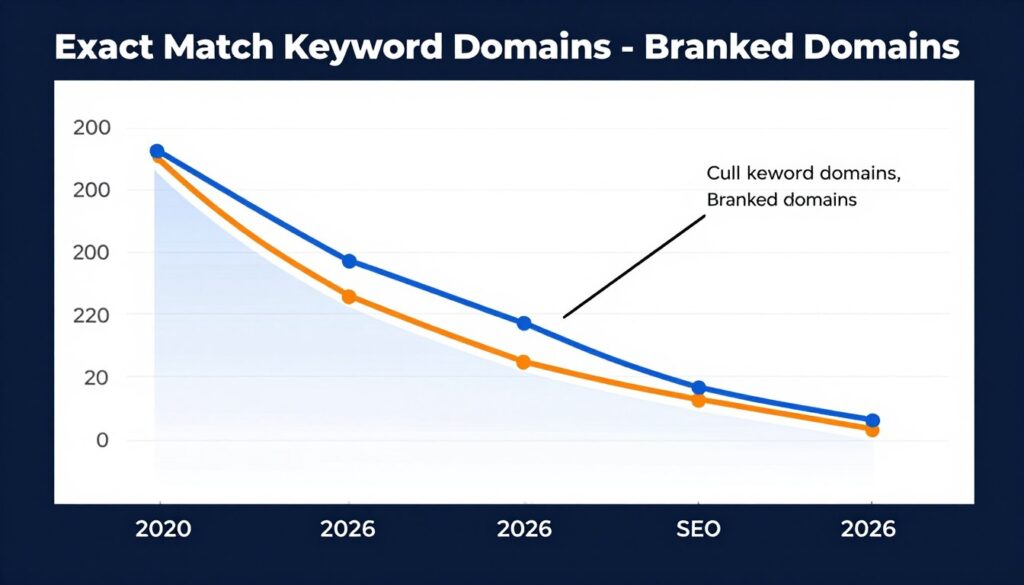
Keywords in domain names offer minor ranking advantages for exact match searches. However, their SEO impact has decreased significantly over the past decade.
Google’s algorithms now prioritize overall website authority, content quality, and user experience over exact match domains (EMDs). A keyword-rich domain without strong content will not rank well.
Research from 2026 SEO studies shows exact match domains provide approximately 3-5% ranking boost for target keywords compared to branded domains with identical backlink profiles.
This modest advantage rarely justifies sacrificing brandability. Most successful companies choose brand-first domains and optimize content for keyword targeting instead.
When Keywords Work
Local service businesses benefit most from keyword-rich domains. “DenverPlumber.com” or “AustinLandscaping.com” instantly communicate service and location.
Niche content sites and blogs can leverage keyword domains effectively. “VeganRecipes.com” or “BudgetTravel.com” clearly indicate topic focus for target audiences.
E-commerce sites selling specific product categories may gain from descriptive domains. “OrganicTeas.com” or “RunningShoes.com” help users immediately understand offerings.
However, even in these scenarios, adding unique branding elements often creates stronger long-term value.
Hybrid Approach: Keywords Plus Brand
Combine keyword elements with brandable terms for balanced approach. “FreshBooks” (bookkeeping), “HubSpot” (marketing hub), “Mailchimp” (email marketing) blend descriptive keywords with memorable branding.
This hybrid strategy captures some keyword relevance while maintaining distinctiveness. You get SEO hints plus brand differentiation.
Consider adding action words, adjectives, or creative modifiers to common keywords. “GlowRecipes” beats plain “Recipes.” “SwiftDelivery” exceeds generic “Delivery.”
Keyword Placement Within Domains
If using keywords, place them at the beginning of your domain name. “MarketingHub.com” performs slightly better than “HubMarketing.com” for “marketing” searches.
Front-loaded keywords appear more natural and receive marginally more search engine weight. They also read more professionally to human visitors.
Avoid stuffing multiple keywords into one domain. “BestCheapFastPizzaDelivery.com” appears spammy, hurts credibility, and actually harms SEO through over-optimization.
Keyword Domain Risks
Exact match keyword domains face higher scrutiny from search engines. Google penalizes low-quality exact match domains more aggressively than branded sites.
Generic keyword domains limit business expansion. “CatFood.com” cannot easily expand into dog products or pet services without brand confusion.
Keyword domains are harder to trademark and legally protect. “BestPhones.com” lacks the distinctiveness required for trademark registration.
Alternative Keyword Strategies
Instead of putting keywords in your domain, optimize other elements: page titles, headings, meta descriptions, URL slugs, and quality content.
Build strong topical authority through comprehensive content that naturally incorporates target keywords. This approach delivers better long-term SEO results than keyword domains.
Focus on creating a memorable brand that people search for directly. Branded search traffic (people searching for “your company name”) is more valuable than generic keyword traffic.
For more detailed strategies on this topic, check our Complete WordPress SEO Checklist 2026 which covers keyword optimization beyond domain names.
Find Your Perfect Domain Balance
Use Arahoster’s AI-powered domain generator to discover names that blend keyword relevance with strong branding. Get instant suggestions optimized for both SEO and memorability.
4. Choose the Right TLD/Extension
Your top-level domain extension significantly impacts trust, memorability, and search visibility. Understanding 2026 TLD landscape helps you make the optimal choice for your specific situation.
The Continuing Dominance of .com
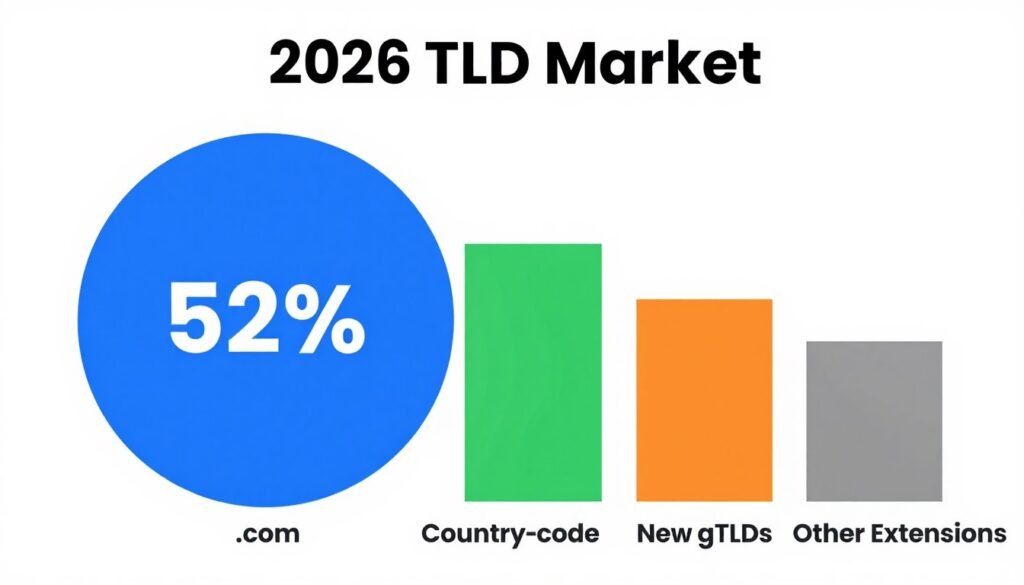
The .com extension remains the gold standard for commercial websites in 2026. It commands 52% of all registered domains and enjoys universal recognition across all demographics.
Consumer trust studies consistently show .com domains receive 39% more clicks than alternative extensions in search results. Users perceive .com as more credible, professional, and established.
If your perfect domain name is available as .com at reasonable price, buy it. The .com extension provides built-in marketing advantage and reduces customer confusion.
When to Choose Alternative Extensions
If your ideal .com is unavailable or prohibitively expensive, strategic alternative extensions offer excellent options. Many successful brands thrive on non-.com domains.
Tech companies successfully use .io (GitHub.io, Notion.io). The extension signals technical sophistication and appeals to developer audiences.
AI-focused businesses increasingly choose .ai extensions. Domains like OpenAI.com and Jasper.ai leverage .ai for immediate industry association.
Creative businesses adopt .co, which reads as “company” and appears modern. Many startups launch successfully on .co domains.
New gTLD Opportunities
Specialized generic TLDs offer branding advantages for specific industries. Consider these emerging extensions:
.tech for technology companies (23,000+ registrations). It immediately communicates your industry focus.
.store and .shop for e-commerce (combined 3.7M registrations). These extensions clarify your business model instantly.
.blog for content publishers (890,000+ registrations). It positions your site as authoritative content source.
.app for mobile applications (650,000+ registrations). Google owns this TLD and requires HTTPS by default.
Country-Code TLDs for Local Business
Country-code top-level domains boost local SEO and build regional trust. They are essential for businesses targeting specific geographic markets.
.uk domains signal British businesses to UK customers. They often outrank .com domains for UK-based searches.
.ca, .au, .de, .fr, and other ccTLDs provide similar advantages in their respective countries.
Some ccTLDs have gained international popularity beyond their countries. .io (British Indian Ocean Territory), .co (Colombia), and .ai (Anguilla) are used globally.
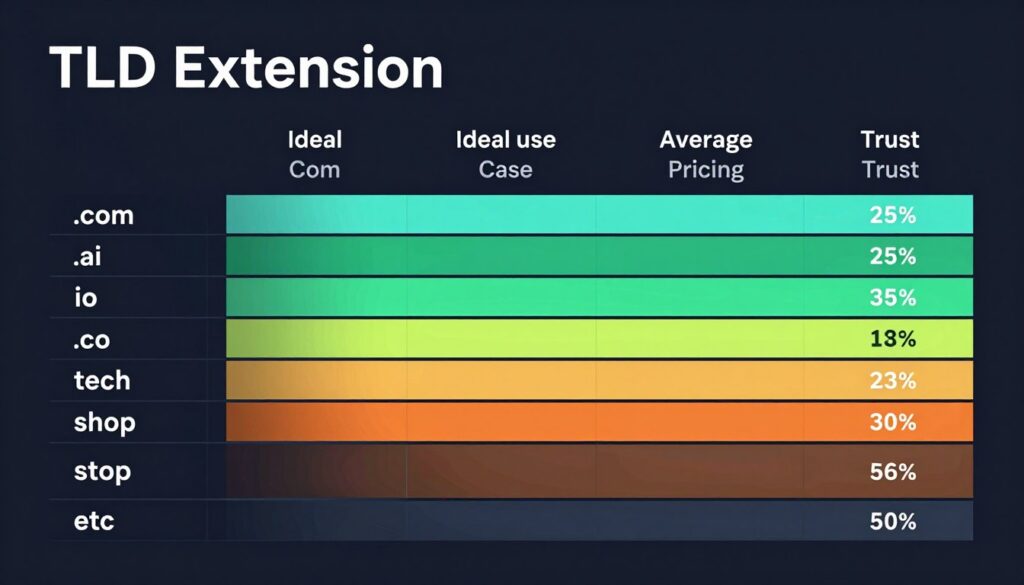
TLD Extension Comparison Table
| Extension | Best For | Trust Level | Avg Price | SEO Impact |
| .com | Any business, universal use | Highest (95%) | $12-15/year | Neutral/Positive |
| .ai | AI companies, tech startups | High (78%) | $80-120/year | Neutral |
| .io | Tech startups, SaaS platforms | High (82%) | $35-50/year | Neutral |
| .co | Startups, modern companies | Medium-High (71%) | $20-30/year | Neutral |
| .net | Network/tech services | High (76%) | $13-17/year | Neutral |
| .org | Non-profits, organizations | High (84%) | $12-16/year | Neutral |
| .shop | E-commerce stores | Medium (64%) | $25-40/year | Slight positive for commerce |
| .tech | Technology businesses | Medium (62%) | $30-45/year | Neutral |
| .store | Retail, e-commerce | Medium (59%) | $25-45/year | Neutral |
| ccTLDs | Country-specific businesses | High in region (88%) | $10-30/year | Positive for local search |
SEO Implications of TLD Choice
Google officially states that new gTLDs receive no inherent SEO penalty or advantage. A .shop domain can rank just as well as .com for relevant queries.
However, user behavior creates indirect SEO effects. Lower click-through rates on unfamiliar extensions reduce traffic and engagement signals, potentially impacting rankings.
Country-code TLDs do influence local search results. A .ca domain receives preference in Canadian search results over international domains.
Multiple TLD Strategy
Purchase multiple extension variants of your primary domain to protect your brand and capture typo traffic. Register at minimum .com, .net, and your country TLD.
Redirect all alternative extensions to your primary domain. This ensures users typing different extensions still reach your site.
For major brands, consider defensive registration of 10-15 relevant extensions to prevent cybersquatting and brand dilution.
5. Avoid Common Mistakes
Learning from others’ domain name mistakes saves time, money, and brand reputation. These common pitfalls derail countless website projects every year.
Numbers in Domain Names
Numbers create confusion about whether to spell them out or use numerals. Is it “4you.com” or “foryou.com”? This ambiguity splits your traffic and weakens brand recall.
Users hearing your domain name verbally will not know if they should type “2” or “two.” Phone conversations become unnecessarily complicated.
The only acceptable number usage is when numbers are integral to your brand name (like “23andMe” genetics company). Otherwise, avoid them completely.
Hyphens Hurt Credibility
Hyphenated domains appear less professional and raise spam suspicions. “best-web-hosting.com” looks significantly less trustworthy than “bestwebhosting.com.”
Hyphens complicate verbal communication. You must specify “hyphen” or “dash” when sharing your domain, adding friction to word-of-mouth marketing.
Search engines treat hyphens as word separators, which can fragment keyword value. Additionally, users often forget to type hyphens, sending traffic to competitor domains.
Exception: If your brand name naturally contains a hyphen (like a trademarked compound word), maintain consistency. Otherwise, never use hyphens.
Confusing Spellings
Creative misspellings rarely justify their marketing drawbacks. Flickr succeeded despite its spelling, not because of it.
Unconventional spellings force customers to remember arbitrary changes. Each spelling quirk adds cognitive load and increases traffic leakage to correctly-spelled variants.
Foreign words, technical jargon, and made-up terms with ambiguous spelling all risk customer confusion. Test pronunciation and spelling comprehension extensively before committing.
Trademark Infringement Risks
Registering domains that infringe existing trademarks invites legal problems and financial losses. Trademark holders can force transfer of infringing domains through UDRP proceedings.
Always search USPTO, EUIPO, and WIPO trademark databases before registering. Check both exact matches and confusingly similar variations.
Even if a trademark exists in a different industry, infringement claims remain possible if there is consumer confusion. Consult intellectual property attorneys for high-stakes domain decisions.
Geographic Limitations
Including city or region names in your domain restricts expansion potential. “SeattleCoffeeCo.com” cannot easily expand to Portland without rebranding.
Geographic domains work for truly local businesses with no expansion plans. Local service companies like plumbers or dentists benefit from location-specific domains for SEO.
For businesses with growth ambitions, choose location-neutral names. You can always emphasize local presence through content and marketing without limiting your domain.
Too Many Keywords
Keyword stuffing produces domains like “BestCheapAffordableLaptopsOnline.com.” These domains appear spammy, hurt credibility, and actually harm SEO through over-optimization.
Google’s algorithms specifically penalize exact match domains with poor content. Keyword-stuffed domains trigger higher scrutiny and quality thresholds.
Limit keyword usage to one or two relevant terms maximum. Better yet, focus on brandability and optimize your content for keywords instead.
Ignoring Social Media Availability
Your domain name should match your social media handles. Inconsistent naming confuses customers and fragments your brand presence.
Before finalizing a domain, check username availability on Instagram, Twitter, Facebook, LinkedIn, TikTok, and YouTube.
If social handles are taken but the domain is available, seriously reconsider your choice. Brand consistency across digital platforms is crucial in 2026.
Neglecting Mobile Typing
Complex domains are difficult to type on mobile devices. Given that 63% of web traffic comes from mobile, typing friction significantly impacts user experience.
Avoid long words, special characters, or unusual letter combinations that are error-prone on touchscreens.
Test typing your domain on both iOS and Android keyboards. If autocorrect constantly changes it or you make frequent typos, choose something simpler.
- Short, memorable names under 15 characters
- Simple spellings anyone can pronounce
- Brand-focused rather than keyword-stuffed
- Clean extensions (.com, .ai, .io, .co)
- Trademark-cleared and legally safe
- Consistent across social media platforms
- Easy to type on mobile devices
Smart Domain Choices
- Numbers that create spelling confusion
- Hyphens that reduce credibility
- Creative spellings that complicate recall
- Trademark infringement risks
- Overly geographic limitations
- Multiple keyword stuffing
- Unavailable social media handles
- Complex mobile typing challenges
Domain Mistakes to Avoid
6. Leverage AI Tools for Domain Generation
Artificial intelligence has revolutionized domain name discovery in 2026. AI-powered tools generate thousands of creative, available suggestions in seconds, dramatically accelerating your naming process.
How AI Domain Generators Work
Modern AI naming tools analyze billions of data points including successful brand names, linguistic patterns, and domain availability databases. They learn what makes names memorable, pronounceable, and brandable.
You input keywords, industry, tone preferences, and name length requirements. The AI instantly generates dozens of original suggestions that match your criteria.
Advanced systems check availability across hundreds of TLD extensions simultaneously. They also verify social media username availability and trademark conflicts.
Top AI Domain Name Tools for 2026
Namelix uses neural networks to generate short, branded names. It learns from your preferences as you save or reject suggestions, improving results over time.
Squadhelp combines AI generation with crowdsourcing. Their platform offers both instant AI suggestions and custom naming contests with professional namers.
Shopify Business Name Generator specializes in e-commerce brands. It creates names optimized for online stores and checks .com availability instantly.
Arahoster AI Domain Finder integrates naming intelligence with instant registration. Search, customize, and register domains without switching platforms.
Benefits of AI-Assisted Naming
Speed represents the primary advantage. What once took days or weeks of brainstorming now happens in minutes.
Creativity gets enhanced beyond human limitations. AI suggests unexpected word combinations and linguistic patterns you might never consider.
Availability filtering saves enormous time. Instead of falling in love with unavailable names, AI only shows realistic options.
Industry optimization ensures suggestions align with your business sector. AI identifies naming conventions and patterns specific to your industry.
Using AI Tools Effectively
Start broad with your initial keywords. Input your industry, product benefits, and emotional associations rather than exact names.
Generate at least 50-100 suggestions before evaluating. Quantity produces quality in AI-assisted naming. Hidden gems often appear in later results.
Combine AI suggestions with human creativity. Use AI output as inspiration, then modify or combine suggestions to create your perfect name.
Test final candidates with real humans. AI cannot fully predict emotional responses or cultural associations. Validate AI suggestions through user testing.
AI Customization Options
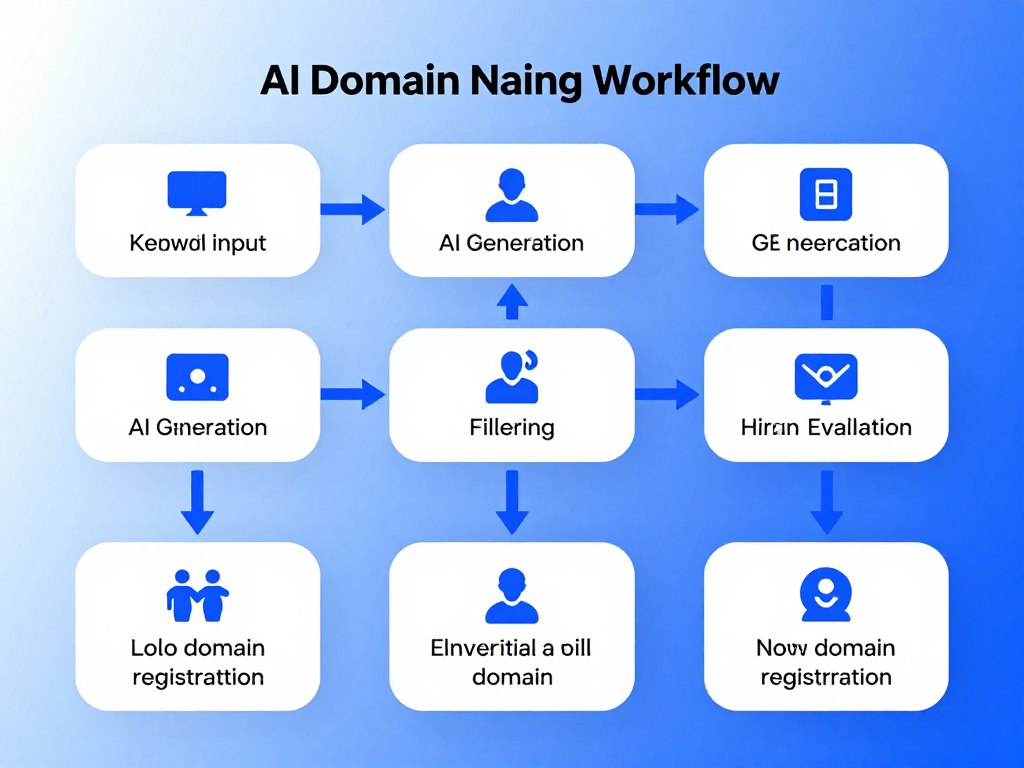
Specify name length preferences. Most AI tools allow filtering by character count to match your brevity requirements.
Choose linguistic styles. Select modern tech-style names, classic professional names, playful creative names, or descriptive functional names.
Set TLD extension priorities. Focus AI search on .com availability, or explore alternative extensions like .ai, .io, or industry-specific gTLDs.
Input competitor domains to avoid similarity. Advanced AI tools analyze competitor names and generate distinctively different options.
AI Limitations to Understand
AI cannot guarantee trademark clearance. Always conduct independent trademark searches on AI-generated suggestions before committing.
Cultural sensitivity requires human judgment. AI may not recognize offensive or problematic meanings in all languages and cultures.
Brand strategy alignment needs human oversight. AI generates names that fit parameters but cannot understand your complete business vision.
Emotional resonance varies by individual. What AI ranks as “highly brandable” may not resonate with your specific target audience.
Discover Your Perfect Domain with AI
Arahoster’s advanced AI domain generator analyzes millions of naming patterns to suggest creative, available options tailored to your business. Get instant results with real-time availability checking across 500+ extensions.
7. Check Availability, Trademarks & Legal Issues
Thorough availability and legal verification prevents costly mistakes. Invest time in comprehensive checks before registering or building brand around any domain name.
Domain Availability Search
Begin with standard domain availability lookup using registrar search tools. Check your preferred name across all relevant extensions (.com, .net, .io, .ai, etc.).
Use bulk search tools to check 50-100 variations simultaneously. Services like DomainWheel, LeanDomainSearch, and Instant Domain Search accelerate this process.
Check availability through multiple registrars. Occasionally, availability data differs between registrars due to database sync timing.
WHOIS Database Research
If your preferred domain shows as taken, investigate current ownership through WHOIS lookup. Identify registration date, expiration date, and ownership details.
Recently expired or soon-expiring domains may become available through drop-catching or backorder services. Domains registered decades ago are less likely to become available.
Parked domains with generic advertising may indicate owner willingness to sell. Contact information in WHOIS enables direct purchase inquiries.
Trademark Database Searches
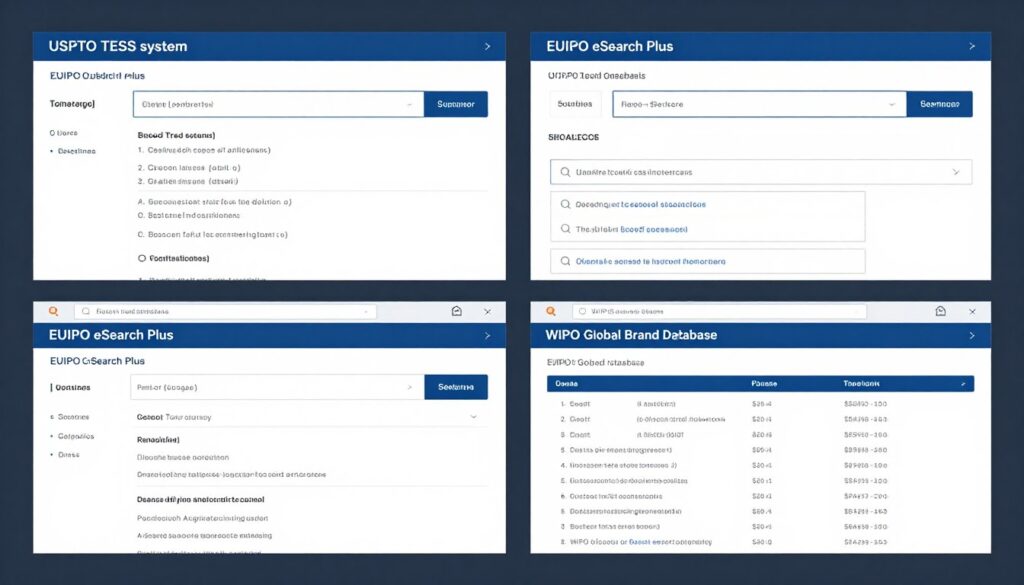
Search USPTO (United States Patent and Trademark Office) database for US trademark conflicts. Access free search at uspto.gov/trademarks.
Check EUIPO (European Union Intellectual Property Office) for EU trademarks if serving European markets. Search at euipo.europa.eu.
Use WIPO Global Brand Database for international trademark research across 55+ national and regional databases. Access at wipo.int.
Search for exact matches and phonetically similar variations. Trademark infringement includes “confusingly similar” marks, not just identical matches.
Social Media Username Availability
Check handle availability on major platforms using tools like Namechk or KnowEm. These services search 100+ social networks simultaneously.
Prioritize Instagram, Facebook, Twitter, LinkedIn, TikTok, and YouTube. Consistent naming across these platforms is essential for brand cohesion.
If your domain name is available but social handles are taken, consider alternative names. Brand fragmentation across platforms confuses customers.
Google Search Verification
Perform comprehensive Google searches for your proposed domain name. Look for existing businesses, products, or content using identical or similar names.
Search in quotation marks for exact phrase matches. Search without quotes for related variations and common misspellings.
Check Google Images for visual brand associations. Ensure no strong existing visual identity conflicts with your proposed name.
Cybersquatting and UDRP
Cybersquatting involves registering domains identical or similar to trademarks with intent to profit. This practice violates ICANN policies and most national laws.
If someone registers a domain infringing your trademark, file UDRP (Uniform Domain-Name Dispute-Resolution Policy) complaint through ICANN-approved providers.
UDRP proceedings typically cost $1,500-3,000 and resolve in 60-90 days. Success requires proving bad faith registration and legitimate trademark rights.
International Considerations
Check your domain name meaning in major languages. Innocent English words may carry offensive or negative meanings elsewhere.
Research pronunciation challenges in different languages. Names that work well in English may be unpronounceable in Asian or European markets.
Consider cultural associations and symbolism. Colors, numbers, and words carry different connotations across cultures.
Legal Consultation
For high-value domains or significant business investments, consult intellectual property attorneys before registering.
Attorneys can conduct comprehensive clearance searches beyond basic database checks. They identify risks and provide legal opinions on domain defensibility.
Legal consultation costs $500-2,000 but prevents potentially catastrophic rebranding costs or legal disputes later.
Essential Verification Checklist
- Domain availability across major TLDs
- WHOIS ownership research
- USPTO trademark search
- EUIPO and WIPO international trademark check
- Social media username availability
- Google search for existing usage
- International meaning verification
- Legal consultation for high-value domains
Red Flags to Avoid
- Existing registered trademarks in your industry
- Active businesses using identical names
- Unavailable social media handles
- Negative meanings in other languages
- Domains recently involved in disputes
- Names similar to major brands
- Confusingly similar to competitors
- Domains parking on your business keywords
8. Buy Multiple Variants & Defensive Domains
Protecting your brand requires more than registering one domain. Strategic acquisition of domain variants prevents traffic loss, competitor exploitation, and brand dilution.
Primary Domain Extensions
Register your exact brand name across core TLD extensions. At minimum, secure .com, .net, and .org variants.
If operating internationally, register country-code TLDs for major markets. A US business serving Canada, UK, and Australia should register .ca, .co.uk, and .com.au.
Redirect all alternative extensions to your primary domain using 301 redirects. This ensures visitors typing different extensions reach your site.
Common Misspelling Protection
Identify and register common misspellings of your domain. Typos account for 5-8% of direct navigation traffic for popular brands.
Register plural and singular variants if applicable. “Product.com” and “Products.com” should both be owned.
Capture reversed word order domains. If you own “GreenLeaf.com,” also register “LeafGreen.com.”
Consider phonetic variations. “Rite,” “Right,” and “Wright” sound identical but lead to different sites.
Hyphenated and Number Variants
Even if your primary domain contains no hyphens or numbers, register hyphenated versions. Users often add unnecessary hyphens when remembering domains.
If your domain includes numbers, register both numeric and spelled-out versions. Own both “4You.com” and “ForYou.com.”
These defensive registrations prevent competitors or bad actors from capitalizing on user confusion.
Brand Protection Domains
Register domains containing your brand name plus common suffixes. “YourBrand” + “Reviews,” “Complaints,” “Scam,” “Sucks,” etc.
Negative suffix domains prevent malicious actors from creating damaging parody or complaint sites. They also capture users researching your reputation.
Major corporations routinely register hundreds of brand-related domains for comprehensive protection.
Future Product and Service Domains
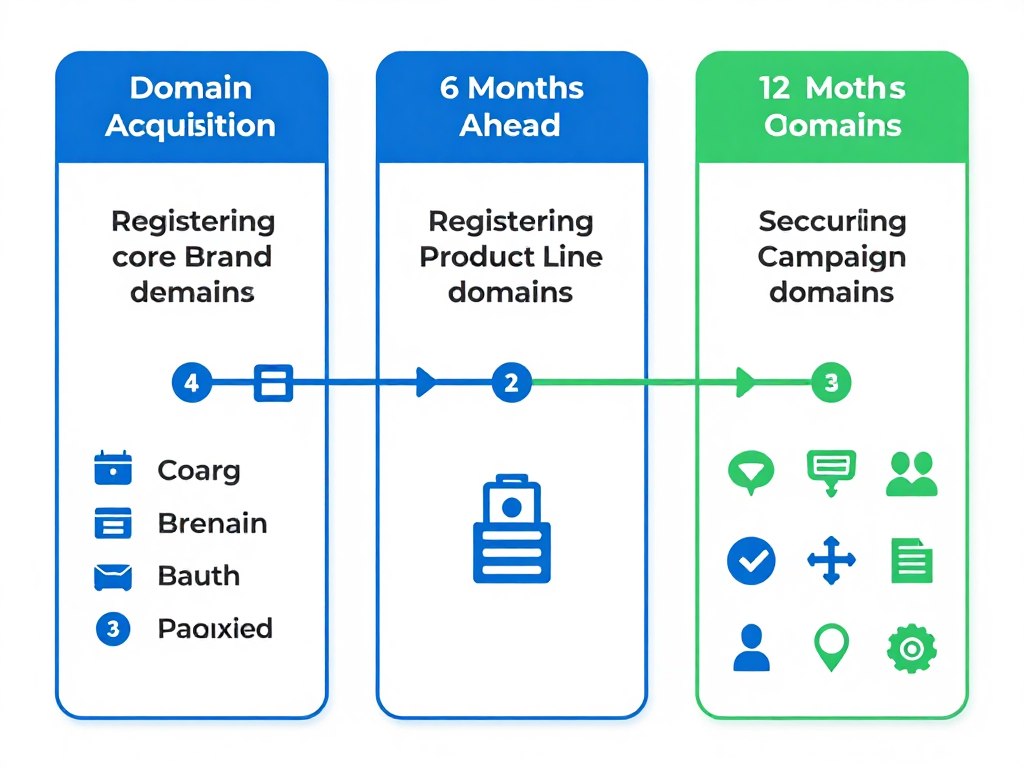
Secure domains for planned future products, services, or business lines before public launch. Competitors monitor trademark filings and domain registrations for intelligence.
Register project codenames or internal working titles. Premature domain exposure can reveal strategic plans to competitors.
Annual domain costs are minimal compared to potential lost opportunities or inflated acquisition prices after public knowledge.
Geographic Expansion Domains
Register ccTLD variants for markets you plan to enter within 2-3 years. Domain prices rarely decrease, and desired names may become unavailable.
Consider domains with city names if planning local expansion. “YourBrandNYC.com” or “YourBrandLondon.com” support localized marketing.
Geographic domains enable geo-targeted advertising campaigns and boost local SEO when properly implemented.
Defensive Budget Planning
Small businesses should budget $200-500 annually for defensive domain registrations (10-20 domains).
Medium businesses typically maintain 30-60 domain variants, costing $600-1,200 per year.
Enterprise brands protect 100-500+ domains at $2,000-10,000+ annually. This investment prevents significantly more expensive cybersquatting disputes or rebranding costs.
Domain Portfolio Management
Use domain portfolio management tools to track renewals, DNS settings, and redirect configurations across all owned domains.
Set auto-renewal for all defensive domains. Accidentally losing a defensive domain to expiration creates immediate vulnerability.
Review portfolio annually to identify unused domains that can be dropped. Some defensive registrations become obsolete as business strategies evolve.
For advanced domain management strategies, explore our Website Security Checklist 2026 which covers DNS security and domain protection best practices.
9. Domain Pricing & Cost Breakdown 2026
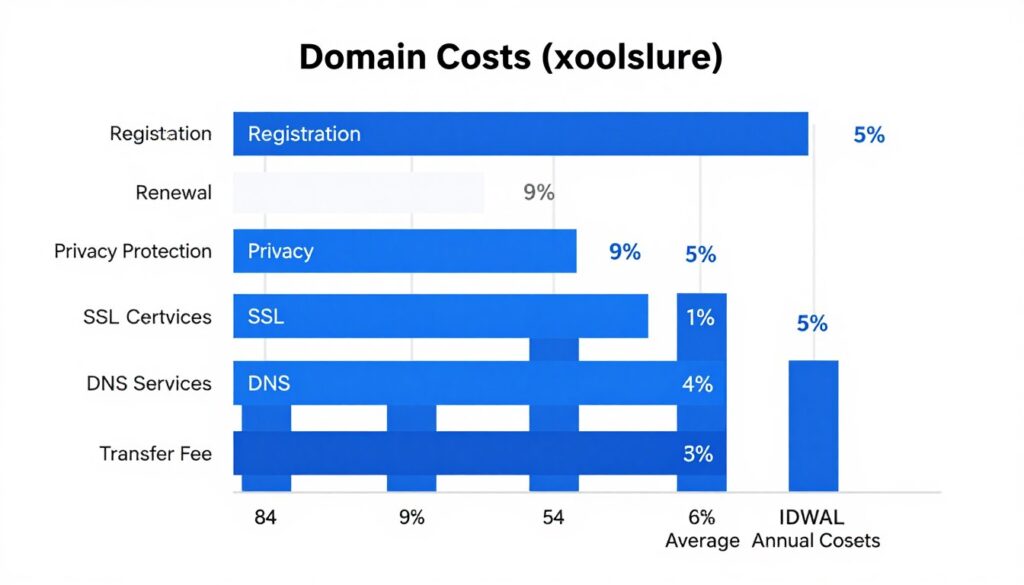
Understanding domain pricing structure helps you budget effectively and avoid unexpected costs. Domain expenses extend beyond initial registration to include renewals, privacy, and premium acquisition.
Standard Registration Costs
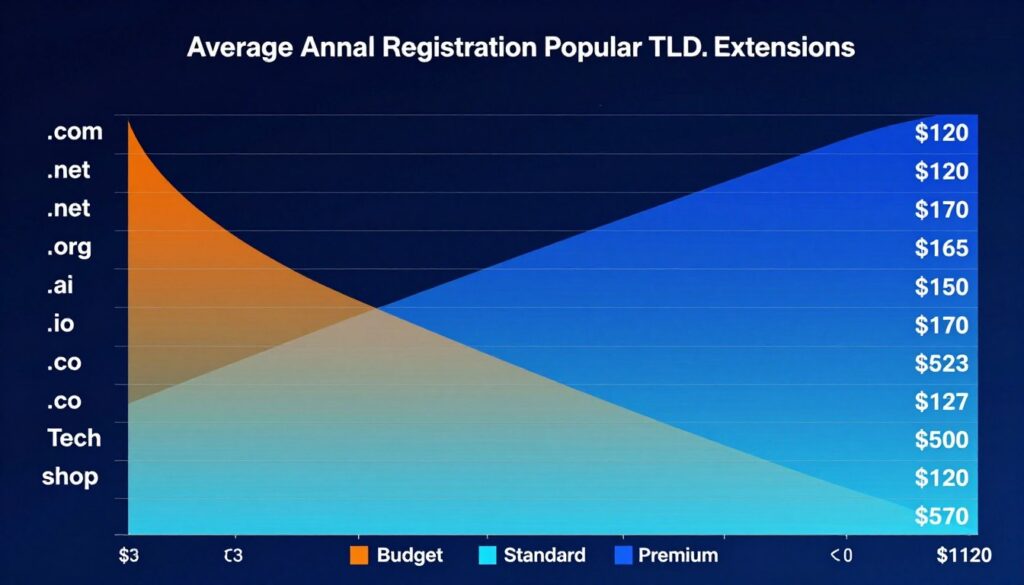
Standard .com domain registrations range from $8.99 to $14.99 per year depending on registrar. Bulk discounts and promotional pricing can reduce costs to $6-8 per domain.
New gTLD extensions vary widely. Budget-friendly options like .online and .site cost $2-5 annually. Premium extensions like .ai and .io range from $30-120 per year.
Country-code TLDs typically cost $10-30 annually. Some ccTLDs like .ws (Samoa) cost under $10, while others like .de (Germany) reach $30-40.
Introductory vs Renewal Pricing
Many registrars offer heavily discounted first-year pricing to attract customers. A $0.99 first-year .com may renew at $14.99 in year two.
Always check renewal rates before registering. The first-year discount is meaningless if you plan to keep the domain long-term.
Calculate total five-year cost to compare registrar value accurately. A $12 flat-rate registrar beats a $1 intro/$15 renewal registrar over time.
Premium Domain Costs
Premium domains with desirable names, keywords, or brandability cost significantly more than standard registration fees.
Registrar-held premium domains range from $50 to $50,000 depending on quality. Short dictionary words typically start at $1,000-5,000.
Aftermarket premium domains (owned by private sellers) span $500 to millions. Negotiate pricing or use escrow services like Escrow.com for high-value transactions.
Privacy Protection Costs
WHOIS privacy protection hides your personal contact information from public databases. This service typically costs $5-15 per domain annually.
Some registrars include free privacy protection with all registrations (Namecheap, Porkbun). Others charge separately or omit it entirely.
Privacy protection prevents spam, identity theft, and unwanted solicitation. Budget for this essential feature on all domains.
SSL Certificate Costs
Secure Socket Layer (SSL) certificates encrypt data between your site and visitors. They are required for HTTPS and impact search rankings.
Free SSL certificates from Let’s Encrypt are available through most modern web hosts. These renew automatically every 90 days at no cost.
Paid SSL certificates range from $10-500 annually depending on validation level. Basic Domain Validation (DV) SSL costs $10-50. Extended Validation (EV) SSL for enterprises costs $150-500.
Domain Transfer Fees
Transferring domains between registrars typically costs equivalent to one-year renewal (often $10-15 for .com). The transfer includes a one-year registration extension.
Some registrars charge additional transfer fees beyond renewal costs. Always verify total transfer cost before initiating.
Transfer fees present minimal barrier to switching registrars if better pricing, features, or support are available elsewhere.
Hidden Costs to Watch
DNS management fees range from free to $50 annually depending on registrar. Most registrars include basic DNS at no charge.
Email forwarding to route domain emails to existing accounts costs $0-20 annually. Many registrars include limited forwarding free.
DNSSEC (security extension) sometimes incurs $5-20 annual fees at budget registrars, though many include it free.
Auto-renewal prevents accidental expiration but can surprise you with unexpected charges. Set calendar reminders to review before renewal dates.
Value Optimization Strategies
Register domains for multiple years upfront to lock in current rates. Multi-year registration protects against price increases.
Buy defensive domains in bulk during registrar sales. Black Friday, Cyber Monday, and registrar anniversaries offer 30-60% discounts.
Use registrar transfer deals strategically. Many registrars offer $3-7 transfer pricing to win customers from competitors.
Avoid registering domains through web hosting companies. Dedicated registrars typically offer better pricing and domain management tools.
Transparent Domain Pricing with Arahoster
No hidden fees, no surprise renewals. Arahoster offers straightforward domain pricing with free WHOIS privacy, free DNS management, and free SSL certificates included. Compare our rates and see the difference.
10. Best Domain Registrars Comparison 2026
Choosing the right domain registrar impacts your costs, security, and management experience for years. This comprehensive comparison helps you select the best registrar for your specific needs.
Top Registrar Overview
The domain registrar landscape in 2026 offers dozens of options ranging from discount providers to full-service platforms. Key differentiators include pricing structure, customer support quality, security features, and user interface design.
Leading registrars serve millions of customers and maintain ICANN accreditation. Avoid obscure or newly-established registrars that lack proven track records.
Consider total cost of ownership beyond initial registration. Factor in renewal pricing, privacy protection, DNS management, and support availability.
Detailed Registrar Comparison
| Registrar | .com Price | Free Privacy | Support | Best For | Rating |
| Namecheap | $8.88/yr (renewal $13.98) | Yes | 24/7 Chat, Email | Budget buyers, privacy | 4.6/5 |
| Porkbun | $9.13/yr (flat renewal) | Yes | Email, Ticket | Best prices, no upsells | 4.8/5 |
| GoDaddy | $11.99/yr (renewal $17.99) | No ($9.99/yr) | 24/7 Phone, Chat | Beginners, hand-holding | 4.2/5 |
| Dynadot | $8.99/yr (renewal $10.99) | Yes | Email, Ticket | Domain investors, bulk | 4.5/5 |
| NameSilo | $8.99/yr (flat renewal) | Yes | Email, Ticket | Portfolio management | 4.4/5 |
| Google Domains | $12/yr (flat renewal) | Yes | Email, Chat | Google ecosystem users | 4.7/5 |
| Hover | $12.99/yr (flat renewal) | Yes | Phone, Email | Clean UI, no upsells | 4.6/5 |
| Arahoster | $10.99/yr (renewal $12.99) | Yes | 24/7 Chat, Email, Phone | Hosting bundles, all-in-one | 4.8/5 |
Namecheap
Namecheap combines competitive pricing with excellent customer service and strong privacy protection. They pioneered free WHOIS privacy and maintain this feature across most TLDs.
Strengths include clean user interface, reliable uptime, and transparent pricing. Their DNS management tools are robust and beginner-friendly.
Weaknesses involve email support delays during peak times and less aggressive promotional pricing compared to competitors. Phone support is not available.
Porkbun
Porkbun has rapidly gained market share through straightforward pricing and minimal upselling. They offer some of the industry’s lowest renewal rates without introductory gimmicks.
Strengths include honest pricing, free SSL certificates, excellent bulk management tools, and quirky but effective branding.
Weaknesses include limited support channels (no phone or live chat) and less extensive knowledge base compared to established competitors.
GoDaddy
GoDaddy remains the largest domain registrar globally with over 80 million domains under management. They excel in customer support and beginner resources.
Strengths include 24/7 phone support, extensive help documentation, and one-stop-shop for domains, hosting, and website builders.
Weaknesses involve aggressive upselling, higher renewal rates, and no free WHOIS privacy. Their interface can feel cluttered with promotional offers.
Dynadot
Dynadot targets domain investors and power users with advanced portfolio management features. They offer excellent bulk pricing and auction platform.
Strengths include sophisticated domain management tools, competitive bulk discounts, and strong marketplace for buying/selling domains.
Weaknesses include steeper learning curve for beginners and limited customer support channels compared to premium registrars.
NameSilo
NameSilo focuses on value pricing without sacrificing essential features. They include free privacy protection and maintain consistent renewal rates.
Strengths include transparent pricing, no hidden fees, free DNS management, and lifetime free privacy protection on eligible TLDs.
Weaknesses involve dated user interface design and limited customer support options (primarily ticket-based).
Google Domains
Google Domains offers simple, straightforward domain registration integrated with Google Workspace and other Google services.
Strengths include clean interface, automatic DNSSEC, excellent integration with Google products, and transparent pricing.
Weaknesses include higher base pricing, limited TLD selection compared to competitors, and uncertainty about long-term commitment to domain business.
Selection Criteria
Choose based on your priorities. Budget-conscious buyers should prioritize Porkbun or NameSilo. Support-focused users benefit from GoDaddy or Arahoster.
Portfolio managers need advanced features from Dynadot. Google ecosystem users find value in Google Domains integration.
Consider trying a registrar with 1-2 domains before migrating your entire portfolio. Experience their interface and support firsthand.
Register Domains with Arahoster’s Complete Solution
Why manage domains and hosting separately? Arahoster integrates domain registration with blazing-fast NVMe hosting, free SSL, one-click WordPress installation, and 24/7 expert support. Simplify your web presence with one trusted provider.
Use code DOMAIN2026 at checkout for exclusive savings on your first domain + hosting bundle!
11. Advanced Domain Tricks
Beyond basic registration, advanced domain strategies help you find hidden opportunities, maximize security, and future-proof your web presence. These tactics separate beginners from domain experts.
Expired Domain Hunting
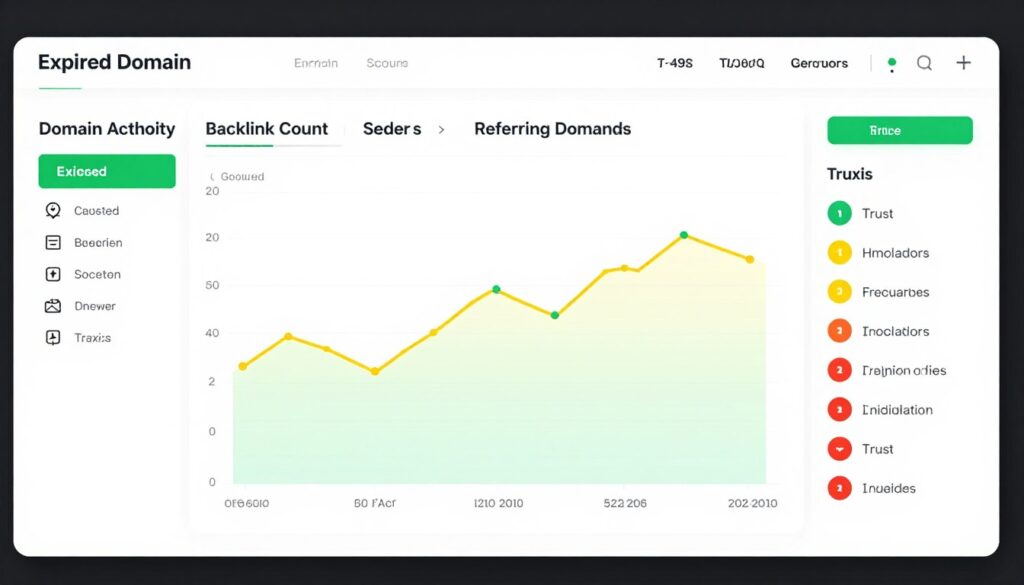
Thousands of valuable domains expire daily when owners forget renewals or abandon projects. These deleted domains re-enter the registration pool with existing backlink profiles and aged authority.
Monitor expiring domains using services like ExpiredDomains.net, FreshDrop.com, or DomCop. Filter by metrics including backlinks, domain authority, and traffic history.
Deleted domains with quality backlinks provide instant SEO advantage. A five-year-old expired domain with 50 relevant backlinks beats brand-new registration for search rankings.
Verify backlink quality before purchasing expired domains. Toxic link profiles require disavowal and may carry penalties. Use Ahrefs, Moz, or SEMrush to audit backlink health.
Domain Backordering
Backorder services let you register domains the moment they become available after expiration. Multiple buyers can backorder the same domain, triggering auctions.
Leading backorder platforms include NameJet, SnapNames, and GoDaddy Auctions. Success rates vary by service and competition level.
Backorder costs range from $20-100 base fee plus winning bid if auction occurs. Budget $100-500 for moderately competitive domains.
Set maximum bid limits to avoid overpaying in auction excitement. Research comparable domain sales before bidding.
Domain Portfolio Management
Serious domain investors and businesses maintain portfolios of 50-500+ domains. Effective management requires systematic organization and strategy.
Use portfolio management software like DomainTools, CatchDrop, or registrar-specific tools. Track renewal dates, costs, DNS settings, and monetization status.
Categorize domains by purpose: core business assets, defensive registrations, investment holdings, and development projects. Apply different renewal strategies to each category.
Conduct annual portfolio audits. Drop underperforming domains that no longer serve strategic purpose. Reinvest savings in higher-value acquisitions.
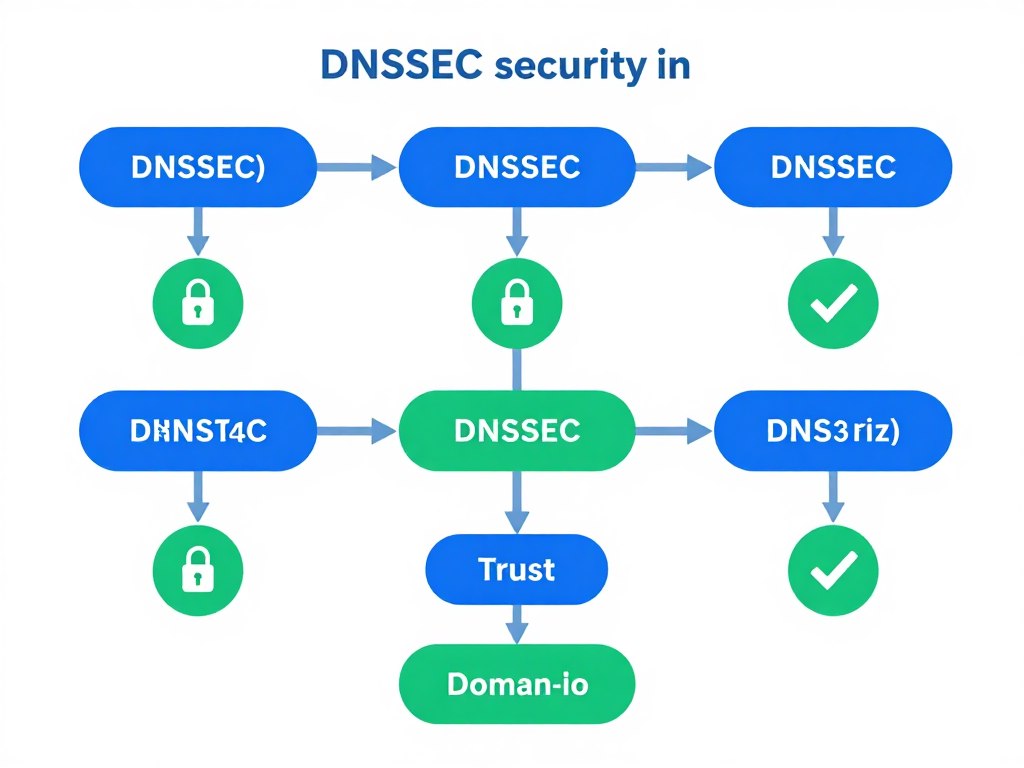
DNSSEC Implementation
DNS Security Extensions (DNSSEC) protect against DNS spoofing and cache poisoning attacks. DNSSEC cryptographically signs DNS records to verify authenticity.
Enable DNSSEC through your registrar’s control panel. Most major registrars offer free DNSSEC as standard feature in 2026.
DNSSEC provides stronger security for high-value domains, financial services, and government organizations. It prevents attackers from redirecting your traffic to malicious sites.
Note that DNSSEC requires compatible DNS hosting. Verify your DNS provider supports DNSSEC before enabling.
DMARC Email Authentication
Domain-based Message Authentication, Reporting, and Conformance (DMARC) prevents email spoofing using your domain. DMARC builds on SPF and DKIM protocols.
Implement DMARC by adding DNS TXT records specifying authentication policies. Start with monitoring mode (p=none) to collect data without blocking emails.
DMARC protects brand reputation by preventing phishing attacks that impersonate your domain. It improves email deliverability to major providers like Gmail and Outlook.
Use free DMARC analyzers like DMARC Analyzer or Postmark to interpret reports and refine policies.
Web3 and Decentralized Domains
Blockchain-based domain names like .eth (Ethereum Name Service) and .crypto (Unstoppable Domains) represent emerging alternative to traditional DNS.
Web3 domains are purchased outright rather than rented annually. You own the domain permanently as a blockchain asset.
These domains resolve to cryptocurrency wallet addresses and decentralized websites. They offer censorship resistance and true ownership.
Adoption remains limited in 2026. Web3 domains work best as supplements to traditional domains, not replacements. Register your brand on major blockchain naming systems for future protection.
Domain Monetization Strategies
Undeveloped domains can generate revenue through parking, affiliate programs, or lead generation landing pages.
Domain parking displays contextual advertising on your unused domains. Services like Sedo, Bodis, or ParkingCrew share ad revenue. Returns are modest ($5-50/month for average domains).
Develop simple affiliate niche sites on keyword domains. A domain like “BestCoffeeMakers.com” can host comparison content with affiliate links.
Create lead generation landing pages that capture contact information for sale to relevant businesses. “LocalPlumbingServices.com” can generate plumber leads.
International Domain Strategies
Internationalized Domain Names (IDNs) allow non-Latin characters in domain names. IDNs support Arabic, Chinese, Cyrillic, and other scripts.
Register IDN variants if serving markets that prefer native language domains. Chinese businesses often register both English and Chinese character versions.
Be aware that IDN adoption varies by region. Research local preferences before investing heavily in non-Latin domains.
For comprehensive security strategies including domain-level protection, review our Website Security Checklist 2026.
Step-by-Step Process: Choosing & Registering Your Perfect Domain in 2026
Follow this systematic approach to navigate domain selection and registration confidently. These steps incorporate all the strategies discussed while providing actionable workflow.
Step 1: Define Your Requirements
Start by clarifying your domain purpose, target audience, and branding goals. Write down 5-10 keywords that describe your business, product, or content focus.
Determine your budget for initial registration and annual renewals. Decide if you need premium domain or can work with standard availability.
Identify must-have TLD extensions (.com, industry-specific, or country-code). Determine if alternative extensions are acceptable fallbacks.
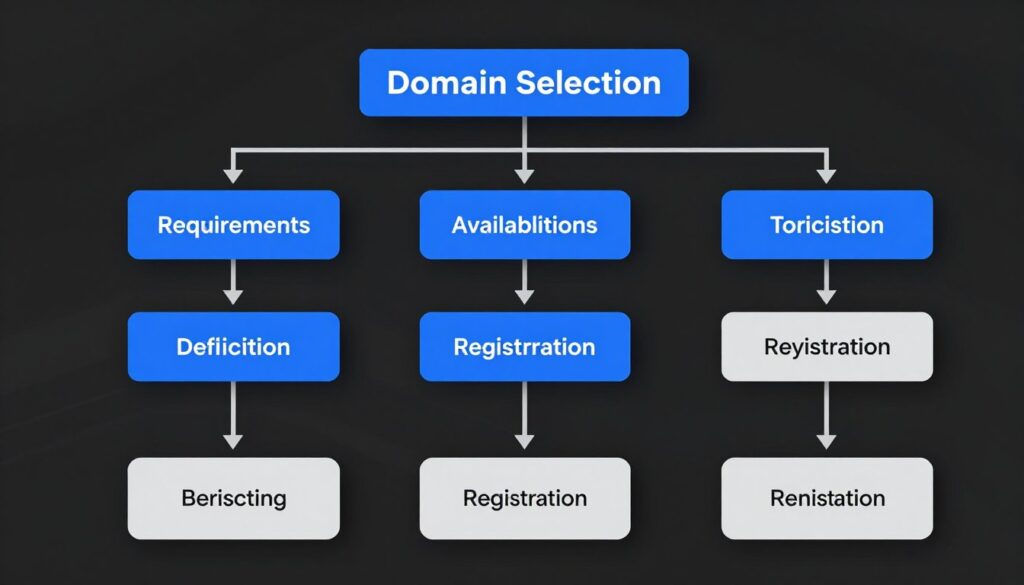
Step 2: Brainstorm Name Options
Generate 30-50 potential domain names using techniques from earlier sections. Combine keywords, create invented words, and explore hybrid approaches.
Use AI domain generators to expand your list beyond initial ideas. Tools like Namelix or Arahoster’s AI Domain Finder suggest creative alternatives.
Apply memorability tests to top candidates. Use the radio test, pronunciation check, and spelling simplicity criteria to filter options.
Step 3: Check Availability
Search for domain availability across your shortlist. Use bulk search tools to check multiple names and extensions simultaneously.
Note which names are available as .com. If .com is taken, check premium marketplace pricing and alternative extension availability.
For taken domains, perform WHOIS lookup to assess likelihood of future availability or purchase opportunity.
Step 4: Conduct Trademark Research
Search USPTO, EUIPO, and WIPO databases for your top 5-10 available domain candidates. Verify no existing trademark conflicts.
Perform comprehensive Google searches for each candidate. Identify existing businesses, products, or strong associations.
Check social media username availability across major platforms. Ensure consistent naming is possible.
Step 5: Validate with Test Audience
Share your top 3-5 domain candidates with trusted friends, colleagues, or target audience members. Gather feedback on memorability, pronunciation, and brand perception.
Ask testers to spell the domain after hearing it once. Track success rates to identify clarity issues.
Request honest reactions about brand fit and professionalism. Negative initial responses often predict market reception.
Step 6: Make Final Selection
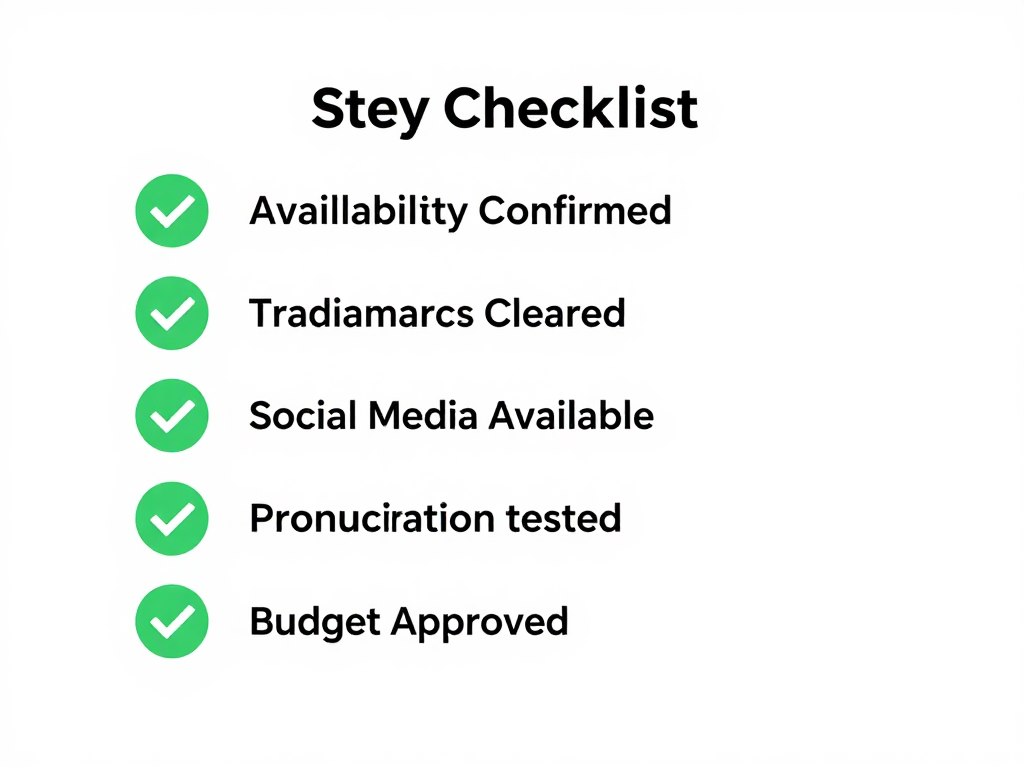
Choose your primary domain based on all previous validation. Select a name that balances availability, brandability, memorability, and legal clearance.
Identify 3-5 defensive domain variants to register alongside your primary choice. Include common misspellings and alternative extensions.
Confirm total budget including primary domain, defensive variants, privacy protection, and first-year hosting costs.
Step 7: Register Your Domains
Select a registrar based on pricing, features, and support needs. Compare options from the registrar comparison section.
Create registrar account with strong, unique password. Enable two-factor authentication for security.
Register primary domain and defensive variants. Add privacy protection, ensure auto-renewal is enabled, and configure DNS settings.
Step 8: Configure Domain Settings
Set up DNS records to point your domain to your web hosting. Most hosts provide nameserver or A record information.
Configure email forwarding if desired. Set up professional email addresses using your new domain.
Implement security features including DNSSEC if available. Verify SSL certificate setup through your hosting provider.
Step 9: Set Up Redirects
Configure 301 permanent redirects from all defensive domain variants to your primary domain. Ensure visitors typing alternative extensions reach your main site.
Test redirects from different devices and browsers. Verify HTTPS works correctly across all domain variants.
Set up any necessary subdomain structures for specific purposes (blog.domain.com, shop.domain.com, etc.).
Step 10: Document and Monitor
Record all domain credentials, renewal dates, and DNS settings in secure password manager. Share access information with relevant team members.
Set calendar reminders for renewal dates 60 days in advance. Even with auto-renewal enabled, monitoring prevents billing surprises.
Monitor domain analytics including direct traffic, search volume for brand terms, and any unauthorized use of your domain names.
Ready to Register Your Perfect Domain?
Arahoster streamlines the entire domain registration process with instant availability search, one-click registration, automatic DNS configuration, and seamless hosting integration. Get your domain live in minutes, not hours.
Plus, bundle your domain with our high-performance NVMe hosting using code DOMAIN2026 and save on your complete website setup!
Full 50-Point Domain Name Checklist 2026
Use this comprehensive checklist to evaluate any domain name before registration. Complete all high-priority items and as many medium-priority items as possible for optimal domain choice.
| Category | Checkpoint | Priority | Status |
| Memorability | Domain is under 15 characters | High | ☐ |
| Memorability | Domain passes the radio test | High | ☐ |
| Memorability | Domain uses simple, phonetic spelling | High | ☐ |
| Memorability | Domain is easy to pronounce in target markets | High | ☐ |
| Memorability | Domain avoids double letters when possible | Medium | ☐ |
| Memorability | Test subjects recall domain after 10 minutes | Medium | ☐ |
| Brandability | Domain is unique and distinctive | High | ☐ |
| Brandability | Domain creates positive associations | High | ☐ |
| Brandability | Domain stands out from competitors | High | ☐ |
| Brandability | Domain allows business scalability | Medium | ☐ |
| Brandability | Domain avoids generic keyword stuffing | Medium | ☐ |
| Keywords | Keywords balance with brand identity | Medium | ☐ |
| Keywords | Domain is not over-optimized | High | ☐ |
| Keywords | Keywords placed at beginning if used | Low | ☐ |
| Extension | .com available or strategic alternative chosen | High | ☐ |
| Extension | Extension matches business type and audience | High | ☐ |
| Extension | Country-code TLD if targeting specific region | Medium | ☐ |
| Technical | Domain contains no numbers | High | ☐ |
| Technical | Domain contains no hyphens | High | ☐ |
| Technical | Domain easy to type on mobile | High | ☐ |
| Technical | Domain avoids confusing spellings | High | ☐ |
| Legal | USPTO trademark search completed | High | ☐ |
| Legal | EUIPO trademark search completed | Medium | ☐ |
| Legal | WIPO international trademark check done | Medium | ☐ |
| Legal | Google search shows no major conflicts | High | ☐ |
| Legal | Domain cleared for trademark registration | Medium | ☐ |
| Availability | Primary domain name available | High | ☐ |
| Availability | Instagram handle available | High | ☐ |
| Availability | Twitter handle available | High | ☐ |
| Availability | Facebook page name available | Medium | ☐ |
| Availability | LinkedIn handle available | Medium | ☐ |
| Availability | YouTube channel name available | Low | ☐ |
| International | Domain has no negative meanings in other languages | High | ☐ |
| International | Domain pronunciation works globally | Medium | ☐ |
| Protection | Common misspellings identified for registration | Medium | ☐ |
| Protection | Alternative extensions planned for purchase | Medium | ☐ |
| Protection | Plural/singular variants identified | Low | ☐ |
| Protection | Hyphenated variant planned for registration | Low | ☐ |
| Testing | Friends/colleagues tested for memorability | High | ☐ |
| Testing | Target audience feedback collected | Medium | ☐ |
| Testing | Spelling test passed with 80%+ success | Medium | ☐ |
| Budget | Registration cost within budget | High | ☐ |
| Budget | Renewal pricing reviewed and acceptable | High | ☐ |
| Budget | Privacy protection cost factored in | Medium | ☐ |
| Budget | Defensive domain budget planned | Medium | ☐ |
| Strategy | Domain supports 5-year business vision | High | ☐ |
| Strategy | Domain works across planned marketing channels | High | ☐ |
| Strategy | Domain builds long-term brand equity | High | ☐ |
| Final Check | You genuinely like and feel confident about domain | High | ☐ |
| Final Check | Domain represents your brand vision accurately | High | ☐ |
Score your domain by counting completed high-priority items. Aim for 100% of high-priority checkpoints and at least 70% of medium-priority items before finalizing registration.
Case Studies: Real Success & Failure Examples
Learning from real-world domain decisions provides invaluable insight. These case studies reveal what works, what fails, and why domain names matter more than many businesses realize.
Success Story: Spotify
Spotify chose an invented brand name combining “spot” and “identify.” The domain Spotify.com was available, short, memorable, and globally pronounceable.
The name had no existing meaning, allowing Spotify to own the term completely. Today, “Spotify” has become a verb meaning “to stream music.”
Key success factors include unique brandability, simple spelling, international appeal, and trademark-ability. Spotify avoided keyword stuffing like “BestMusicStreaming.com” which would have limited brand power.
Success Story: Zoom
Zoom.us launched with a ccTLD because Zoom.com was owned by another company. Despite the non-.com start, Zoom succeeded through product excellence.
In 2018, Zoom acquired Zoom.com for undisclosed amount. The premium domain investment reflected their scale and brand protection strategy.
Key lessons include short, memorable names transcending TLD limitations, and strategic domain upgrades as businesses grow. Zoom.us did not prevent initial success but Zoom.com enhanced professional credibility.
Failure Story: AnalTech.com
Analytical Technologies chose AnalTech.com without recognizing the unfortunate visual similarity to an offensive term. The scientific instrumentation company faced years of embarrassing misreadings.
The domain cost them business partnerships and credibility. Eventually they rebranded to a different domain after significant expense.
Key lesson involves thoroughly vetting domains for unintended meanings, visual misreadings, and pronunciation issues across languages and audiences.
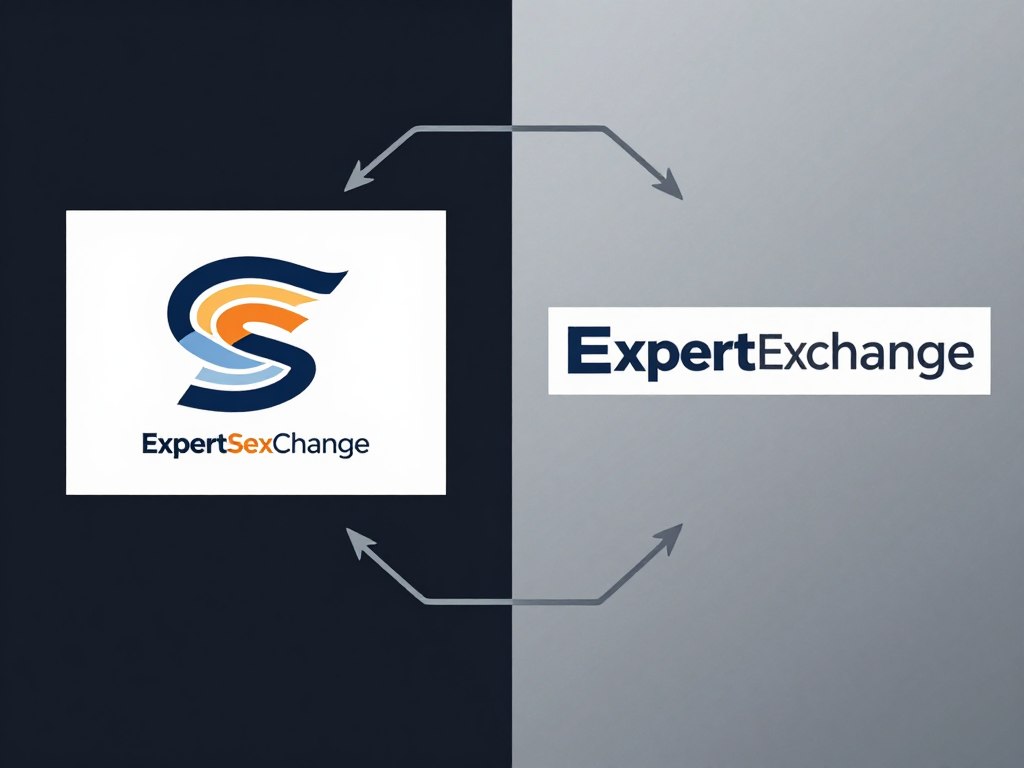
Failure Story: ExpertSexChange.com
Expert Sex Change initially appeared as the domain name without spacing, creating embarrassing misreading. The site was actually Experts Exchange, a programmer Q&A platform.
They redesigned their logo to ExpertsExchange.com with clear word separation, but damage to brand perception persisted for years.
Key lesson highlights importance of evaluating domain spacing, visual parsing, and potential misinterpretations before registration and branding.
Success Story: Ahrefs
Ahrefs built a $100M+ SEO tool company on a .com domain that is intentionally misspelled (“refs” with “href” tag reference). The unusual spelling became memorable brand asset.
The domain violated traditional naming advice about simple spelling, yet succeeded because it was distinctive, relevant to technical audience, and consistently executed.
Key lesson shows unconventional domains can work when there is strong product-market fit and the target audience appreciates the wordplay.
Success Story: Booking.com
Booking.com built a €90+ billion company on a generic keyword domain. Their success appears to contradict advice about brandable over keyword-heavy names.
However, Booking.com succeeded despite not because of their generic domain. Massive marketing investment and superior product overcame branding limitations.
Key lesson recognizes that exceptional execution can overcome domain disadvantages, but choosing a better domain from the start would have provided additional advantage.
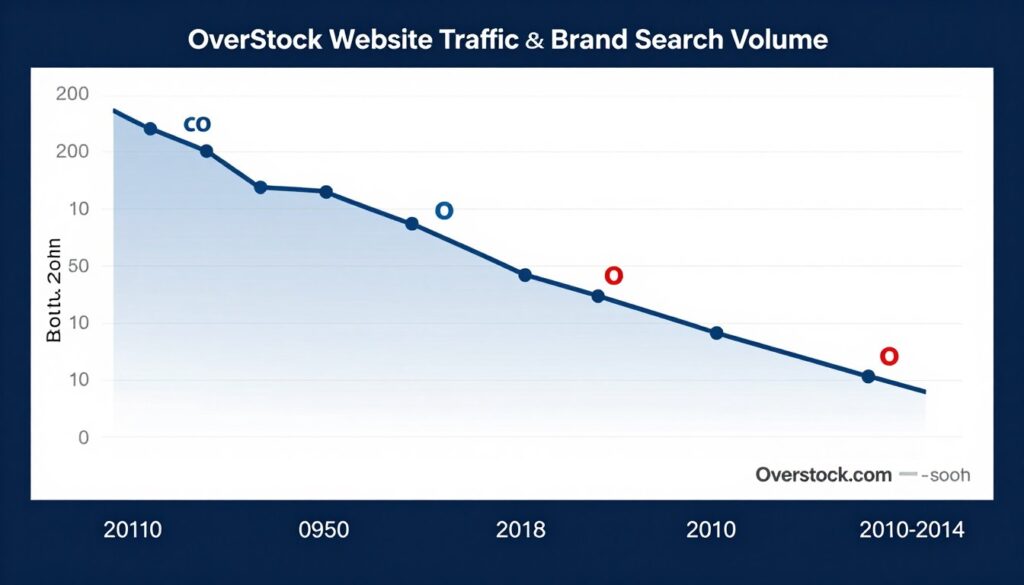
Failure Story: Overstock.com
Overstock.com spent $3.5 million purchasing O.co and rebranding their entire e-commerce platform to the short domain in 2011.
The rebrand failed spectacularly. Customers did not understand or remember O.co. The company reverted to Overstock.com within three years, wasting millions.
Key lesson demonstrates that established brand equity often outweighs theoretical domain advantages. Rebranding to “better” domains can destroy customer recognition.
Common Success Patterns
Successful domain stories share these characteristics: memorable and unique, easy to spell and pronounce, available across social platforms, supportive of long-term vision, and free from legal conflicts.
Product quality matters more than perfect domains. Great companies succeed with imperfect domains through execution excellence.
Domain choices amplify or hinder success but rarely determine it alone. View domains as important but not exclusive success factors.
Common Failure Patterns
Domain failures typically involve unintended meanings or embarrassing misreadings, overly generic names lacking differentiation, expensive rebrands from established names, trademark conflicts and legal disputes, and names limiting business expansion.
Most domain mistakes are preventable through thorough research and testing described in earlier sections.
How Arahoster Makes Domain + Hosting Seamless
Finding the perfect domain name is just the beginning. You need reliable hosting infrastructure to bring your vision to life. Arahoster integrates premium domain services with high-performance hosting for complete web presence solutions.
Unified Domain & Hosting Platform
Managing domains and hosting through separate providers creates unnecessary complexity. Different login portals, inconsistent support, and DNS configuration challenges slow your progress.
Arahoster consolidates everything into one intuitive dashboard. Search domains, register instantly, configure DNS, and deploy hosting without switching platforms.
This integration eliminates technical headaches for beginners while offering advanced controls that developers and agencies require.
Lightning-Fast NVMe SSD Hosting
Your perfect domain deserves equally perfect hosting infrastructure. Arahoster exclusively uses NVMe SSD storage that delivers 6x faster performance than traditional SSD hosting.
Page load speed directly impacts SEO rankings, user experience, and conversion rates. Slow hosting undermines all your domain branding efforts.
Our NVMe infrastructure ensures your site loads in under 2 seconds, meeting 2026 Core Web Vitals standards and Google’s performance expectations.
For detailed speed optimization strategies, see our article on Top 10 Mistakes Killing Your Website Speed 2026.
Free SSL Certificates Included
SSL certificates are mandatory for modern websites. HTTPS encrypts visitor data, builds trust, and improves search rankings.
Arahoster includes free automatic SSL certificates on all hosting plans. Your domain automatically receives HTTPS without additional cost or technical configuration.
SSL certificates auto-renew every 90 days. You never worry about expiration warnings or security lapses.
One-Click WordPress Installation
WordPress powers 43% of all websites in 2026. Its flexibility, extensive plugin ecosystem, and user-friendly interface make it the ideal platform for most projects.
Arahoster offers true one-click WordPress installation. Your domain becomes a fully functional WordPress site in under 60 seconds.
Pre-configured security settings, automatic updates, and performance optimization come standard. Focus on content and design rather than technical setup.
Explore advanced WordPress strategies in our WordPress Master Guide 2026.
Advanced Security Features
Domain and hosting security protects your brand investment. Arahoster implements multiple security layers to safeguard your online presence.
Free WHOIS privacy protection shields your personal information from public databases. Prevent spam, identity theft, and unwanted solicitation.
DDoS protection defends against traffic-based attacks. Our infrastructure automatically filters malicious traffic before it reaches your site.
Daily automated backups ensure you can restore your site if anything goes wrong. Backups are retained for 30 days with one-click restoration.
Web Application Firewall (WAF) blocks common vulnerabilities and attacks. Protect against SQL injection, XSS, and other exploit attempts.
For comprehensive protection strategies, review our Website Security Checklist 2026.
24/7 Expert Support
Technical issues do not respect business hours. Arahoster provides round-the-clock support through multiple channels.
Live chat support connects you with knowledgeable technicians in under 2 minutes. Get real-time help without waiting for email responses.
Phone support is available for urgent issues. Speak directly with support engineers who understand both domain and hosting technicalities.
Comprehensive knowledge base contains hundreds of tutorials, guides, and troubleshooting articles. Find answers instantly to common questions.
Scalable Hosting Plans
Your hosting needs grow with your business. Arahoster offers seamless scalability from entry-level shared hosting to enterprise dedicated servers.
Start small with shared hosting for $4.99/month. Upgrade to VPS or dedicated servers as traffic increases, without changing domains or migration hassles.
All plans include same-day account activation, free site migrations from other hosts, and 30-day money-back guarantee.
Domain + Hosting Bundle Benefits
Bundling your domain registration with Arahoster hosting provides exclusive advantages and cost savings.
First-year domain registration free with annual hosting plans. This promotion includes .com, .net, .org, and select other extensions.
Simplified billing consolidates domain renewals and hosting payments into single invoice. Manage all expenses through one account.
Optimized DNS performance leverages Arahoster’s global infrastructure. Your domain resolves faster for visitors worldwide.
Get Your Complete Website Solution Today
Stop managing domains and hosting separately. Arahoster’s integrated platform combines premium domain registration, blazing-fast NVMe hosting, free SSL, automatic backups, and 24/7 support in one affordable package.
Use code DOMAIN2026 at checkout to save 20% on your first year of domain + hosting bundle. Limited time offer!
Frequently Asked Questions About Domain Names in 2026
Does my domain TLD extension affect SEO in 2026?
Google officially states that new gTLDs receive no inherent ranking advantage or penalty compared to .com domains. A .shop or .tech domain can rank equally well for relevant searches.
However, country-code TLDs (ccTLDs) do influence local search results. A .uk domain receives preference in UK search results, while .ca domains rank better in Canada.
User behavior creates indirect SEO effects. Unfamiliar extensions may receive lower click-through rates in search results, potentially impacting rankings over time.
Is .ai worth the premium price for non-AI businesses?
The .ai extension commands premium pricing (-120/year) compared to .com (-15/year). This investment makes sense primarily for artificial intelligence, machine learning, and tech companies where .ai signals industry focus.
For non-AI businesses, .ai rarely justifies the cost unless you found the perfect brandable name unavailable elsewhere. The extension will not boost SEO or conversions for unrelated industries.
Consider .ai if your brand name naturally fits the extension and you serve tech-savvy audiences. Otherwise, allocate budget to marketing rather than premium TLDs.
How do I buy premium domains owned by others?
Start by performing WHOIS lookup to identify current owner contact information. Many domain owners list email addresses for direct purchase inquiries.
Use domain marketplaces like Sedo, Afternic, or Flippa to search for domains available for sale. These platforms facilitate negotiations and secure transactions.
Make professional purchase offers through domain brokers who specialize in negotiations. Brokers typically charge 10-15% commission but secure better prices.
Use escrow services like Escrow.com for high-value transactions above
Frequently Asked Questions About Domain Names in 2026
Does my domain TLD extension affect SEO in 2026?
Google officially states that new gTLDs receive no inherent ranking advantage or penalty compared to .com domains. A .shop or .tech domain can rank equally well for relevant searches.
However, country-code TLDs (ccTLDs) do influence local search results. A .uk domain receives preference in UK search results, while .ca domains rank better in Canada.
User behavior creates indirect SEO effects. Unfamiliar extensions may receive lower click-through rates in search results, potentially impacting rankings over time.
Is .ai worth the premium price for non-AI businesses?
The .ai extension commands premium pricing ($80-120/year) compared to .com ($10-15/year). This investment makes sense primarily for artificial intelligence, machine learning, and tech companies where .ai signals industry focus.
For non-AI businesses, .ai rarely justifies the cost unless you found the perfect brandable name unavailable elsewhere. The extension will not boost SEO or conversions for unrelated industries.
Consider .ai if your brand name naturally fits the extension and you serve tech-savvy audiences. Otherwise, allocate budget to marketing rather than premium TLDs.
How do I buy premium domains owned by others?
Start by performing WHOIS lookup to identify current owner contact information. Many domain owners list email addresses for direct purchase inquiries.
Use domain marketplaces like Sedo, Afternic, or Flippa to search for domains available for sale. These platforms facilitate negotiations and secure transactions.
Make professional purchase offers through domain brokers who specialize in negotiations. Brokers typically charge 10-15% commission but secure better prices.
Use escrow services like Escrow.com for high-value transactions above $1,000. Escrow protects both buyer and seller during domain transfer and payment.
What are the best cheap domain registrars with good service?
Porkbun offers the best overall value with flat $9-10/year .com renewals and no hidden fees. They include free WHOIS privacy and SSL certificates.
Namecheap provides excellent service at competitive pricing ($8.88 first year, $13.98 renewal). Their customer support and user interface are industry-leading.
NameSilo maintains consistent pricing around $8.99/year with lifetime free privacy protection. Their interface is dated but functional.
Avoid extremely cheap promotional pricing ($0.99 first year) if renewal rates spike to $17-20. Calculate five-year total cost for accurate comparison.
Should I register my domain for multiple years?
Multi-year registration offers several advantages. You lock in current pricing against future increases, avoid annual renewal tasks, and demonstrate long-term commitment to search engines.
Register important business domains for 3-5 years to protect against accidental expiration and price volatility. The upfront cost is minimal compared to rebranding costs if you lose a domain.
For experimental projects or uncertain ventures, single-year registration reduces risk. You can always extend registration later if the project succeeds.
Enable auto-renewal regardless of registration length. This prevents accidental expiration if you forget renewal dates.
Can I change my domain name after launching my website?
You can change domains after launch, but the process requires careful planning to minimize SEO impact and customer confusion.
Implement 301 permanent redirects from your old domain to new domain for all pages. This transfers most link equity and signals the move to search engines.
Update all backlinks you control including social media profiles, business listings, and partner sites. Maintain old domain for at least 12 months to capture redirected traffic.
Expect temporary ranking fluctuations and traffic loss during transition. Most sites recover within 3-6 months with proper technical implementation.
Avoid domain changes unless absolutely necessary. Strong brand recognition built on your original domain has significant value.
Do I need WHOIS privacy protection?
Yes, WHOIS privacy protection is highly recommended for all domains. Public WHOIS databases expose your personal contact information including name, address, email, and phone number.
Without privacy protection, you will receive spam emails, phone solicitations, and potential identity theft risks. Marketers scrape WHOIS data for contact lists.
Privacy protection typically costs $5-15/year or comes free with many registrars. Some registrars like Namecheap and Porkbun include it at no charge.
Business domains may intentionally keep WHOIS public for transparency and trust signals. Individual bloggers and small businesses should always use privacy protection.
What happens if my domain expires?
Domain expiration follows a multi-stage process with opportunities for recovery before complete deletion.
Grace Period (0-30 days after expiration): Your domain stops resolving but remains renewable at standard price. Most registrars send multiple reminder emails.
Redemption Period (30-60 days): Domain is deactivated and requires expensive redemption fee ($100-200) plus renewal to recover.
Pending Delete (60-75 days): Domain enters deletion queue and cannot be recovered by original owner. It becomes available for anyone to register after deletion.
Enable auto-renewal and keep payment methods current to avoid expiration. Set calendar reminders 60 days before renewal dates as backup.
Are exact match domains (EMDs) still valuable in 2026?
Exact match domains (EMDs) provide minimal SEO advantage in 2026 compared to previous years. Google’s algorithms have evolved to prioritize content quality over domain keywords.
EMDs work best for local service businesses where geographic keywords matter. “DenverPlumber.com” clearly communicates service and location to users and search engines.
However, EMDs limit branding potential and often appear less trustworthy than unique brand names. “BestCheapLaptops.com” looks spammy compared to a distinctive brand.
Focus on creating a memorable brand rather than keyword-matching domain. Invest in quality content and link building for SEO rather than relying on domain keywords.
How do I protect my brand with defensive domains?
Register common misspellings of your primary domain to capture typo traffic. Identify 5-10 most likely spelling variations.
Secure your brand name across major TLD extensions including .com, .net, .org, and relevant country-code domains for your markets.
Register plural and singular variants if applicable. Own both “Product.com” and “Products.com” to prevent competitors from capitalizing on confusion.
Consider registering negative suffix domains like “YourBrand” + “Reviews,” “Complaints,” or “Scam” to prevent malicious use.
Budget $200-500 annually for defensive domains as business insurance. This investment prevents significantly more expensive disputes or rebranding later.
Should I buy a domain even if I am not ready to launch?
Yes, secure great domains immediately when you find them. Available domains disappear quickly, and you may never find your perfect name again at standard pricing.
Domain registration costs $10-15 annually for .com. This minimal investment protects your option while you develop your business plan and website.
Competitors and domain investors actively monitor new business trends. Waiting to register domains after public announcements often means losing names to speculators.
Park registered domains with “coming soon” page until ready to launch. This prevents others from taking the domain and starts building anticipation.
Set up simple landing page with email capture to collect interested users before full launch. Validate market interest while holding your domain.
What is domain flipping and is it profitable?
Domain flipping involves buying domains at standard registration prices and reselling them to interested buyers at higher prices.
Successful domain flipping requires identifying valuable domains before others, understanding market trends, and negotiating effectively with buyers.
Profit margins range from $50 to $50,000+ per domain depending on quality. Premium single-word .com domains can sell for six to seven figures.
However, most domains never sell. Only 1-3% of registered domains flip profitably. Success demands significant market knowledge, patience, and holding costs.
Beginners should focus on building businesses rather than domain speculation. Flipping works best for experienced investors with domain portfolios.
Do hyphens in domains hurt SEO?
Hyphens in domains do not directly penalize SEO, but they create user experience problems that indirectly harm rankings.
Hyphenated domains appear less professional and raise spam concerns. Users instinctively trust “bestmarketing.com” more than “best-marketing.com.”
Hyphens complicate verbal communication. You must specify “dash” or “hyphen” when sharing your domain, adding friction to word-of-mouth marketing.
Many users forget to type hyphens, sending traffic to competitor’s non-hyphenated domain. This traffic leakage represents lost business opportunity.
Search engines treat hyphens as word separators, which can fragment keyword value. Avoid hyphens unless your trademarked brand name naturally includes one.
Can I transfer my domain to a different registrar?
Yes, domains are portable between registrars. ICANN regulations guarantee your right to transfer domains after initial 60-day lock period.
Domain transfers typically cost equivalent to one-year renewal and include a one-year registration extension. Most transfers complete within 5-7 days.
Unlock your domain at current registrar and obtain authorization code (EPP code). Initiate transfer at new registrar using this code.
Verify your domain is not within 60 days of expiration or initial registration. These time periods temporarily prevent transfers.
Ensure WHOIS email address is current and accessible. You will receive transfer confirmation emails requiring response to complete the process.
What is DNSSEC and do I need it?
DNSSEC (Domain Name System Security Extensions) adds cryptographic signatures to DNS records to verify authenticity and prevent spoofing attacks.
DNSSEC protects against DNS cache poisoning where attackers redirect your domain traffic to malicious servers. This security is especially important for financial services and high-value sites.
Most major registrars offer free DNSSEC support in 2026. Enable it through your registrar’s control panel if available.
DNSSEC requires compatible DNS hosting. Verify your DNS provider supports DNSSEC before enabling. Some budget hosts may not offer compatibility.
For most small business websites, DNSSEC provides marginal security improvement. Focus first on SSL certificates, strong passwords, and regular backups.
Are .io domains good for non-tech businesses?
The .io extension has become strongly associated with tech startups, SaaS platforms, and developer tools. It signals technical sophistication to tech-savvy audiences.
.io works well for technology businesses, software companies, and digital services. It is less suitable for traditional businesses, local services, or non-tech consumer brands.
.io domains cost $35-50/year compared to $10-15 for .com. This premium only makes sense if the extension aligns with your brand positioning.
Consumer recognition of .io remains lower than .com. Older demographics and non-technical audiences may not immediately recognize .io as legitimate domain extension.
Consider .io if you serve developer audiences or want to signal tech-forward positioning. Otherwise, stick with .com or industry-specific alternatives.
How long should I keep expired domains I bought?
Expired domains purchased for SEO benefit require 6-12 months of quality content development before showing significant ranking improvements.
Build 10-20 high-quality articles on the expired domain addressing topics relevant to its historical focus. This demonstrates legitimate revival to search engines.
Monitor domain metrics including organic traffic, ranking positions, and backlink profile health. Improvements typically appear gradually over several months.
If expired domain shows no positive movement after 12 months of quality content, it may carry undetected penalties. Consider cutting losses and focusing on new domains.
Profitable expired domains justify continued investment through increasing organic traffic, improving rankings, or revenue generation opportunities.
Should I use my personal name as a domain?
Personal name domains work excellently for consultants, coaches, speakers, authors, and personal brands. They establish you as the authority and face of your business.
FirstnameLastname.com provides strong foundation for personal branding across industries. It is professional, clear, and positions you as expert rather than faceless company.
However, personal name domains limit business scalability and exit opportunities. A company named after founder is harder to sell than independently-branded business.
Consider hybrid approach using personal name for thought leadership platform while building separately-branded business for products or services.
If your name is common or difficult to spell, creative alternatives like FirstnameM.com (middle initial) or NicknameLastname.com may work better.
What are Web3 domains and should I register them?
Web3 domains like .eth (Ethereum Name Service) and .crypto (Unstoppable Domains) are blockchain-based naming systems outside traditional DNS structure.
These domains resolve cryptocurrency wallet addresses and decentralized websites. They offer censorship resistance and true ownership without annual renewals.
Web3 domain adoption remains limited in 2026. Most internet users cannot access blockchain domains without browser extensions or special DNS configuration.
Register Web3 versions of your brand name for future protection, but do not rely on them as primary domain strategy. Maintain traditional .com presence for mainstream accessibility.
Web3 domains cost $40-500 for one-time purchase depending on name desirability and extension. Consider it speculative investment in potential future internet infrastructure.
How do I check if a domain was previously penalized by Google?
Use Wayback Machine (archive.org) to view historical versions of the domain. Look for spammy content, unrelated niches, or suspicious link building.
Check backlink profiles using Ahrefs, SEMrush, or Moz. Look for unnatural anchor text patterns, links from low-quality sites, or sudden link velocity spikes.
Search “site:domain.com” in Google. If the domain shows zero indexed pages despite age and backlinks, it may carry severe penalty.
Review domain authority metrics across multiple tools. Domains with many backlinks but low authority scores may have been devalued.
Consider ordering professional domain audit from SEO service if investing significant money in expired domain. This costs $100-300 but prevents expensive mistakes.
,000. Escrow protects both buyer and seller during domain transfer and payment.
What are the best cheap domain registrars with good service?
Porkbun offers the best overall value with flat -10/year .com renewals and no hidden fees. They include free WHOIS privacy and SSL certificates.
Namecheap provides excellent service at competitive pricing (.88 first year, .98 renewal). Their customer support and user interface are industry-leading.
NameSilo maintains consistent pricing around .99/year with lifetime free privacy protection. Their interface is dated but functional.
Avoid extremely cheap promotional pricing (
Frequently Asked Questions About Domain Names in 2026
Does my domain TLD extension affect SEO in 2026?
Google officially states that new gTLDs receive no inherent ranking advantage or penalty compared to .com domains. A .shop or .tech domain can rank equally well for relevant searches.
However, country-code TLDs (ccTLDs) do influence local search results. A .uk domain receives preference in UK search results, while .ca domains rank better in Canada.
User behavior creates indirect SEO effects. Unfamiliar extensions may receive lower click-through rates in search results, potentially impacting rankings over time.
Is .ai worth the premium price for non-AI businesses?
The .ai extension commands premium pricing ($80-120/year) compared to .com ($10-15/year). This investment makes sense primarily for artificial intelligence, machine learning, and tech companies where .ai signals industry focus.
For non-AI businesses, .ai rarely justifies the cost unless you found the perfect brandable name unavailable elsewhere. The extension will not boost SEO or conversions for unrelated industries.
Consider .ai if your brand name naturally fits the extension and you serve tech-savvy audiences. Otherwise, allocate budget to marketing rather than premium TLDs.
How do I buy premium domains owned by others?
Start by performing WHOIS lookup to identify current owner contact information. Many domain owners list email addresses for direct purchase inquiries.
Use domain marketplaces like Sedo, Afternic, or Flippa to search for domains available for sale. These platforms facilitate negotiations and secure transactions.
Make professional purchase offers through domain brokers who specialize in negotiations. Brokers typically charge 10-15% commission but secure better prices.
Use escrow services like Escrow.com for high-value transactions above $1,000. Escrow protects both buyer and seller during domain transfer and payment.
What are the best cheap domain registrars with good service?
Porkbun offers the best overall value with flat $9-10/year .com renewals and no hidden fees. They include free WHOIS privacy and SSL certificates.
Namecheap provides excellent service at competitive pricing ($8.88 first year, $13.98 renewal). Their customer support and user interface are industry-leading.
NameSilo maintains consistent pricing around $8.99/year with lifetime free privacy protection. Their interface is dated but functional.
Avoid extremely cheap promotional pricing ($0.99 first year) if renewal rates spike to $17-20. Calculate five-year total cost for accurate comparison.
Should I register my domain for multiple years?
Multi-year registration offers several advantages. You lock in current pricing against future increases, avoid annual renewal tasks, and demonstrate long-term commitment to search engines.
Register important business domains for 3-5 years to protect against accidental expiration and price volatility. The upfront cost is minimal compared to rebranding costs if you lose a domain.
For experimental projects or uncertain ventures, single-year registration reduces risk. You can always extend registration later if the project succeeds.
Enable auto-renewal regardless of registration length. This prevents accidental expiration if you forget renewal dates.
Can I change my domain name after launching my website?
You can change domains after launch, but the process requires careful planning to minimize SEO impact and customer confusion.
Implement 301 permanent redirects from your old domain to new domain for all pages. This transfers most link equity and signals the move to search engines.
Update all backlinks you control including social media profiles, business listings, and partner sites. Maintain old domain for at least 12 months to capture redirected traffic.
Expect temporary ranking fluctuations and traffic loss during transition. Most sites recover within 3-6 months with proper technical implementation.
Avoid domain changes unless absolutely necessary. Strong brand recognition built on your original domain has significant value.
Do I need WHOIS privacy protection?
Yes, WHOIS privacy protection is highly recommended for all domains. Public WHOIS databases expose your personal contact information including name, address, email, and phone number.
Without privacy protection, you will receive spam emails, phone solicitations, and potential identity theft risks. Marketers scrape WHOIS data for contact lists.
Privacy protection typically costs $5-15/year or comes free with many registrars. Some registrars like Namecheap and Porkbun include it at no charge.
Business domains may intentionally keep WHOIS public for transparency and trust signals. Individual bloggers and small businesses should always use privacy protection.
What happens if my domain expires?
Domain expiration follows a multi-stage process with opportunities for recovery before complete deletion.
Grace Period (0-30 days after expiration): Your domain stops resolving but remains renewable at standard price. Most registrars send multiple reminder emails.
Redemption Period (30-60 days): Domain is deactivated and requires expensive redemption fee ($100-200) plus renewal to recover.
Pending Delete (60-75 days): Domain enters deletion queue and cannot be recovered by original owner. It becomes available for anyone to register after deletion.
Enable auto-renewal and keep payment methods current to avoid expiration. Set calendar reminders 60 days before renewal dates as backup.
Are exact match domains (EMDs) still valuable in 2026?
Exact match domains (EMDs) provide minimal SEO advantage in 2026 compared to previous years. Google’s algorithms have evolved to prioritize content quality over domain keywords.
EMDs work best for local service businesses where geographic keywords matter. “DenverPlumber.com” clearly communicates service and location to users and search engines.
However, EMDs limit branding potential and often appear less trustworthy than unique brand names. “BestCheapLaptops.com” looks spammy compared to a distinctive brand.
Focus on creating a memorable brand rather than keyword-matching domain. Invest in quality content and link building for SEO rather than relying on domain keywords.
How do I protect my brand with defensive domains?
Register common misspellings of your primary domain to capture typo traffic. Identify 5-10 most likely spelling variations.
Secure your brand name across major TLD extensions including .com, .net, .org, and relevant country-code domains for your markets.
Register plural and singular variants if applicable. Own both “Product.com” and “Products.com” to prevent competitors from capitalizing on confusion.
Consider registering negative suffix domains like “YourBrand” + “Reviews,” “Complaints,” or “Scam” to prevent malicious use.
Budget $200-500 annually for defensive domains as business insurance. This investment prevents significantly more expensive disputes or rebranding later.
Should I buy a domain even if I am not ready to launch?
Yes, secure great domains immediately when you find them. Available domains disappear quickly, and you may never find your perfect name again at standard pricing.
Domain registration costs $10-15 annually for .com. This minimal investment protects your option while you develop your business plan and website.
Competitors and domain investors actively monitor new business trends. Waiting to register domains after public announcements often means losing names to speculators.
Park registered domains with “coming soon” page until ready to launch. This prevents others from taking the domain and starts building anticipation.
Set up simple landing page with email capture to collect interested users before full launch. Validate market interest while holding your domain.
What is domain flipping and is it profitable?
Domain flipping involves buying domains at standard registration prices and reselling them to interested buyers at higher prices.
Successful domain flipping requires identifying valuable domains before others, understanding market trends, and negotiating effectively with buyers.
Profit margins range from $50 to $50,000+ per domain depending on quality. Premium single-word .com domains can sell for six to seven figures.
However, most domains never sell. Only 1-3% of registered domains flip profitably. Success demands significant market knowledge, patience, and holding costs.
Beginners should focus on building businesses rather than domain speculation. Flipping works best for experienced investors with domain portfolios.
Do hyphens in domains hurt SEO?
Hyphens in domains do not directly penalize SEO, but they create user experience problems that indirectly harm rankings.
Hyphenated domains appear less professional and raise spam concerns. Users instinctively trust “bestmarketing.com” more than “best-marketing.com.”
Hyphens complicate verbal communication. You must specify “dash” or “hyphen” when sharing your domain, adding friction to word-of-mouth marketing.
Many users forget to type hyphens, sending traffic to competitor’s non-hyphenated domain. This traffic leakage represents lost business opportunity.
Search engines treat hyphens as word separators, which can fragment keyword value. Avoid hyphens unless your trademarked brand name naturally includes one.
Can I transfer my domain to a different registrar?
Yes, domains are portable between registrars. ICANN regulations guarantee your right to transfer domains after initial 60-day lock period.
Domain transfers typically cost equivalent to one-year renewal and include a one-year registration extension. Most transfers complete within 5-7 days.
Unlock your domain at current registrar and obtain authorization code (EPP code). Initiate transfer at new registrar using this code.
Verify your domain is not within 60 days of expiration or initial registration. These time periods temporarily prevent transfers.
Ensure WHOIS email address is current and accessible. You will receive transfer confirmation emails requiring response to complete the process.
What is DNSSEC and do I need it?
DNSSEC (Domain Name System Security Extensions) adds cryptographic signatures to DNS records to verify authenticity and prevent spoofing attacks.
DNSSEC protects against DNS cache poisoning where attackers redirect your domain traffic to malicious servers. This security is especially important for financial services and high-value sites.
Most major registrars offer free DNSSEC support in 2026. Enable it through your registrar’s control panel if available.
DNSSEC requires compatible DNS hosting. Verify your DNS provider supports DNSSEC before enabling. Some budget hosts may not offer compatibility.
For most small business websites, DNSSEC provides marginal security improvement. Focus first on SSL certificates, strong passwords, and regular backups.
Are .io domains good for non-tech businesses?
The .io extension has become strongly associated with tech startups, SaaS platforms, and developer tools. It signals technical sophistication to tech-savvy audiences.
.io works well for technology businesses, software companies, and digital services. It is less suitable for traditional businesses, local services, or non-tech consumer brands.
.io domains cost $35-50/year compared to $10-15 for .com. This premium only makes sense if the extension aligns with your brand positioning.
Consumer recognition of .io remains lower than .com. Older demographics and non-technical audiences may not immediately recognize .io as legitimate domain extension.
Consider .io if you serve developer audiences or want to signal tech-forward positioning. Otherwise, stick with .com or industry-specific alternatives.
How long should I keep expired domains I bought?
Expired domains purchased for SEO benefit require 6-12 months of quality content development before showing significant ranking improvements.
Build 10-20 high-quality articles on the expired domain addressing topics relevant to its historical focus. This demonstrates legitimate revival to search engines.
Monitor domain metrics including organic traffic, ranking positions, and backlink profile health. Improvements typically appear gradually over several months.
If expired domain shows no positive movement after 12 months of quality content, it may carry undetected penalties. Consider cutting losses and focusing on new domains.
Profitable expired domains justify continued investment through increasing organic traffic, improving rankings, or revenue generation opportunities.
Should I use my personal name as a domain?
Personal name domains work excellently for consultants, coaches, speakers, authors, and personal brands. They establish you as the authority and face of your business.
FirstnameLastname.com provides strong foundation for personal branding across industries. It is professional, clear, and positions you as expert rather than faceless company.
However, personal name domains limit business scalability and exit opportunities. A company named after founder is harder to sell than independently-branded business.
Consider hybrid approach using personal name for thought leadership platform while building separately-branded business for products or services.
If your name is common or difficult to spell, creative alternatives like FirstnameM.com (middle initial) or NicknameLastname.com may work better.
What are Web3 domains and should I register them?
Web3 domains like .eth (Ethereum Name Service) and .crypto (Unstoppable Domains) are blockchain-based naming systems outside traditional DNS structure.
These domains resolve cryptocurrency wallet addresses and decentralized websites. They offer censorship resistance and true ownership without annual renewals.
Web3 domain adoption remains limited in 2026. Most internet users cannot access blockchain domains without browser extensions or special DNS configuration.
Register Web3 versions of your brand name for future protection, but do not rely on them as primary domain strategy. Maintain traditional .com presence for mainstream accessibility.
Web3 domains cost $40-500 for one-time purchase depending on name desirability and extension. Consider it speculative investment in potential future internet infrastructure.
How do I check if a domain was previously penalized by Google?
Use Wayback Machine (archive.org) to view historical versions of the domain. Look for spammy content, unrelated niches, or suspicious link building.
Check backlink profiles using Ahrefs, SEMrush, or Moz. Look for unnatural anchor text patterns, links from low-quality sites, or sudden link velocity spikes.
Search “site:domain.com” in Google. If the domain shows zero indexed pages despite age and backlinks, it may carry severe penalty.
Review domain authority metrics across multiple tools. Domains with many backlinks but low authority scores may have been devalued.
Consider ordering professional domain audit from SEO service if investing significant money in expired domain. This costs $100-300 but prevents expensive mistakes.
.99 first year) if renewal rates spike to -20. Calculate five-year total cost for accurate comparison.
Should I register my domain for multiple years?
Multi-year registration offers several advantages. You lock in current pricing against future increases, avoid annual renewal tasks, and demonstrate long-term commitment to search engines.
Register important business domains for 3-5 years to protect against accidental expiration and price volatility. The upfront cost is minimal compared to rebranding costs if you lose a domain.
For experimental projects or uncertain ventures, single-year registration reduces risk. You can always extend registration later if the project succeeds.
Enable auto-renewal regardless of registration length. This prevents accidental expiration if you forget renewal dates.
Can I change my domain name after launching my website?
You can change domains after launch, but the process requires careful planning to minimize SEO impact and customer confusion.
Implement 301 permanent redirects from your old domain to new domain for all pages. This transfers most link equity and signals the move to search engines.
Update all backlinks you control including social media profiles, business listings, and partner sites. Maintain old domain for at least 12 months to capture redirected traffic.
Expect temporary ranking fluctuations and traffic loss during transition. Most sites recover within 3-6 months with proper technical implementation.
Avoid domain changes unless absolutely necessary. Strong brand recognition built on your original domain has significant value.
Do I need WHOIS privacy protection?
Yes, WHOIS privacy protection is highly recommended for all domains. Public WHOIS databases expose your personal contact information including name, address, email, and phone number.
Without privacy protection, you will receive spam emails, phone solicitations, and potential identity theft risks. Marketers scrape WHOIS data for contact lists.
Privacy protection typically costs -15/year or comes free with many registrars. Some registrars like Namecheap and Porkbun include it at no charge.
Business domains may intentionally keep WHOIS public for transparency and trust signals. Individual bloggers and small businesses should always use privacy protection.
What happens if my domain expires?
Domain expiration follows a multi-stage process with opportunities for recovery before complete deletion.
Grace Period (0-30 days after expiration): Your domain stops resolving but remains renewable at standard price. Most registrars send multiple reminder emails.
Redemption Period (30-60 days): Domain is deactivated and requires expensive redemption fee (0-200) plus renewal to recover.
Pending Delete (60-75 days): Domain enters deletion queue and cannot be recovered by original owner. It becomes available for anyone to register after deletion.
Enable auto-renewal and keep payment methods current to avoid expiration. Set calendar reminders 60 days before renewal dates as backup.
Are exact match domains (EMDs) still valuable in 2026?
Exact match domains (EMDs) provide minimal SEO advantage in 2026 compared to previous years. Google’s algorithms have evolved to prioritize content quality over domain keywords.
EMDs work best for local service businesses where geographic keywords matter. “DenverPlumber.com” clearly communicates service and location to users and search engines.
However, EMDs limit branding potential and often appear less trustworthy than unique brand names. “BestCheapLaptops.com” looks spammy compared to a distinctive brand.
Focus on creating a memorable brand rather than keyword-matching domain. Invest in quality content and link building for SEO rather than relying on domain keywords.
How do I protect my brand with defensive domains?
Register common misspellings of your primary domain to capture typo traffic. Identify 5-10 most likely spelling variations.
Secure your brand name across major TLD extensions including .com, .net, .org, and relevant country-code domains for your markets.
Register plural and singular variants if applicable. Own both “Product.com” and “Products.com” to prevent competitors from capitalizing on confusion.
Consider registering negative suffix domains like “YourBrand” + “Reviews,” “Complaints,” or “Scam” to prevent malicious use.
Budget 0-500 annually for defensive domains as business insurance. This investment prevents significantly more expensive disputes or rebranding later.
Should I buy a domain even if I am not ready to launch?
Yes, secure great domains immediately when you find them. Available domains disappear quickly, and you may never find your perfect name again at standard pricing.
Domain registration costs -15 annually for .com. This minimal investment protects your option while you develop your business plan and website.
Competitors and domain investors actively monitor new business trends. Waiting to register domains after public announcements often means losing names to speculators.
Park registered domains with “coming soon” page until ready to launch. This prevents others from taking the domain and starts building anticipation.
Set up simple landing page with email capture to collect interested users before full launch. Validate market interest while holding your domain.
What is domain flipping and is it profitable?
Domain flipping involves buying domains at standard registration prices and reselling them to interested buyers at higher prices.
Successful domain flipping requires identifying valuable domains before others, understanding market trends, and negotiating effectively with buyers.
Profit margins range from to ,000+ per domain depending on quality. Premium single-word .com domains can sell for six to seven figures.
However, most domains never sell. Only 1-3% of registered domains flip profitably. Success demands significant market knowledge, patience, and holding costs.
Beginners should focus on building businesses rather than domain speculation. Flipping works best for experienced investors with domain portfolios.
Do hyphens in domains hurt SEO?
Hyphens in domains do not directly penalize SEO, but they create user experience problems that indirectly harm rankings.
Hyphenated domains appear less professional and raise spam concerns. Users instinctively trust “bestmarketing.com” more than “best-marketing.com.”
Hyphens complicate verbal communication. You must specify “dash” or “hyphen” when sharing your domain, adding friction to word-of-mouth marketing.
Many users forget to type hyphens, sending traffic to competitor’s non-hyphenated domain. This traffic leakage represents lost business opportunity.
Search engines treat hyphens as word separators, which can fragment keyword value. Avoid hyphens unless your trademarked brand name naturally includes one.
Can I transfer my domain to a different registrar?
Yes, domains are portable between registrars. ICANN regulations guarantee your right to transfer domains after initial 60-day lock period.
Domain transfers typically cost equivalent to one-year renewal and include a one-year registration extension. Most transfers complete within 5-7 days.
Unlock your domain at current registrar and obtain authorization code (EPP code). Initiate transfer at new registrar using this code.
Verify your domain is not within 60 days of expiration or initial registration. These time periods temporarily prevent transfers.
Ensure WHOIS email address is current and accessible. You will receive transfer confirmation emails requiring response to complete the process.
What is DNSSEC and do I need it?
DNSSEC (Domain Name System Security Extensions) adds cryptographic signatures to DNS records to verify authenticity and prevent spoofing attacks.
DNSSEC protects against DNS cache poisoning where attackers redirect your domain traffic to malicious servers. This security is especially important for financial services and high-value sites.
Most major registrars offer free DNSSEC support in 2026. Enable it through your registrar’s control panel if available.
DNSSEC requires compatible DNS hosting. Verify your DNS provider supports DNSSEC before enabling. Some budget hosts may not offer compatibility.
For most small business websites, DNSSEC provides marginal security improvement. Focus first on SSL certificates, strong passwords, and regular backups.
Are .io domains good for non-tech businesses?
The .io extension has become strongly associated with tech startups, SaaS platforms, and developer tools. It signals technical sophistication to tech-savvy audiences.
.io works well for technology businesses, software companies, and digital services. It is less suitable for traditional businesses, local services, or non-tech consumer brands.
.io domains cost -50/year compared to -15 for .com. This premium only makes sense if the extension aligns with your brand positioning.
Consumer recognition of .io remains lower than .com. Older demographics and non-technical audiences may not immediately recognize .io as legitimate domain extension.
Consider .io if you serve developer audiences or want to signal tech-forward positioning. Otherwise, stick with .com or industry-specific alternatives.
How long should I keep expired domains I bought?
Expired domains purchased for SEO benefit require 6-12 months of quality content development before showing significant ranking improvements.
Build 10-20 high-quality articles on the expired domain addressing topics relevant to its historical focus. This demonstrates legitimate revival to search engines.
Monitor domain metrics including organic traffic, ranking positions, and backlink profile health. Improvements typically appear gradually over several months.
If expired domain shows no positive movement after 12 months of quality content, it may carry undetected penalties. Consider cutting losses and focusing on new domains.
Profitable expired domains justify continued investment through increasing organic traffic, improving rankings, or revenue generation opportunities.
Should I use my personal name as a domain?
Personal name domains work excellently for consultants, coaches, speakers, authors, and personal brands. They establish you as the authority and face of your business.
FirstnameLastname.com provides strong foundation for personal branding across industries. It is professional, clear, and positions you as expert rather than faceless company.
However, personal name domains limit business scalability and exit opportunities. A company named after founder is harder to sell than independently-branded business.
Consider hybrid approach using personal name for thought leadership platform while building separately-branded business for products or services.
If your name is common or difficult to spell, creative alternatives like FirstnameM.com (middle initial) or NicknameLastname.com may work better.
What are Web3 domains and should I register them?
Web3 domains like .eth (Ethereum Name Service) and .crypto (Unstoppable Domains) are blockchain-based naming systems outside traditional DNS structure.
These domains resolve cryptocurrency wallet addresses and decentralized websites. They offer censorship resistance and true ownership without annual renewals.
Web3 domain adoption remains limited in 2026. Most internet users cannot access blockchain domains without browser extensions or special DNS configuration.
Register Web3 versions of your brand name for future protection, but do not rely on them as primary domain strategy. Maintain traditional .com presence for mainstream accessibility.
Web3 domains cost -500 for one-time purchase depending on name desirability and extension. Consider it speculative investment in potential future internet infrastructure.
How do I check if a domain was previously penalized by Google?
Use Wayback Machine (archive.org) to view historical versions of the domain. Look for spammy content, unrelated niches, or suspicious link building.
Check backlink profiles using Ahrefs, SEMrush, or Moz. Look for unnatural anchor text patterns, links from low-quality sites, or sudden link velocity spikes.
Search “site:domain.com” in Google. If the domain shows zero indexed pages despite age and backlinks, it may carry severe penalty.
Review domain authority metrics across multiple tools. Domains with many backlinks but low authority scores may have been devalued.
Consider ordering professional domain audit from SEO service if investing significant money in expired domain. This costs 0-300 but prevents expensive mistakes.
Conclusion: Secure Your Perfect Domain Today
Your domain name represents your digital identity for years to come. The decisions you make today impact your brand recognition, search visibility, customer trust, and long-term business success.
We have covered everything you need to know about choosing domain names in 2026. From memorability principles to TLD selection, AI tools to registrar comparisons, trademark research to defensive strategies.
The domain landscape continues evolving with new extensions, AI naming tools, and changing user behaviors. However, fundamental principles remain constant: choose names that are short, memorable, brandable, and legally clear.
Do not let perfect be the enemy of good. Your “perfect” domain may be taken or unaffordable. Focus on finding an excellent available option rather than waiting indefinitely for an impossible ideal.
Take action now. Available domains disappear daily to competitors and investors. The domain name you skip today might cost ten times more or become completely unavailable tomorrow.
Your Next Steps
Start by brainstorming 20-30 potential names using the techniques from this guide. Combine keywords, invent new words, and explore creative combinations.
Use AI domain generators to expand your list beyond initial ideas. Check availability across multiple TLD extensions.
Verify trademark clearance for your top candidates. Ensure social media handles are available to maintain brand consistency.
Test memorability with friends and colleagues. Gather honest feedback before committing to registration.
Register your chosen domain along with key defensive variants. Enable privacy protection and configure auto-renewal to protect your investment.
Bundle your domain with reliable hosting to get your website live quickly. Do not let registered domains sit unused for months.
Arahoster: Your Domain & Hosting Partner
Ready to transform your domain into a thriving website? Arahoster provides the complete solution you need.
Our platform combines intuitive domain search with instant registration, premium hosting infrastructure, and expert support. Everything you need to succeed online in one place.
NVMe SSD hosting delivers blazing speed for superior user experience and SEO performance. Free SSL certificates, automatic backups, and robust security protect your investment.
One-click WordPress installation gets you online in minutes. 24/7 expert support ensures you are never stuck with technical issues.
Explore comprehensive resources including our Best Web Hosting 2026 Comparison, Complete WordPress SEO Checklist 2026, and Best AI Tools for WordPress 2026.
Launch Your Website Today with Confidence
Stop researching and start building. Arahoster’s integrated domain + hosting platform eliminates complexity so you can focus on growing your business. Join thousands of satisfied customers who chose Arahoster for reliable, high-performance web hosting.
Use exclusive code DOMAIN2026 at checkout to save 20% on your first year of domain + hosting bundle. Limited time offer ends soon!
Your online success story begins with the right domain name and reliable hosting. The tools, knowledge, and resources are all here. Now it is time to take action.
Register your domain today. Build your website. Grow your business. Your perfect domain name is waiting.
Last updated: March 2026